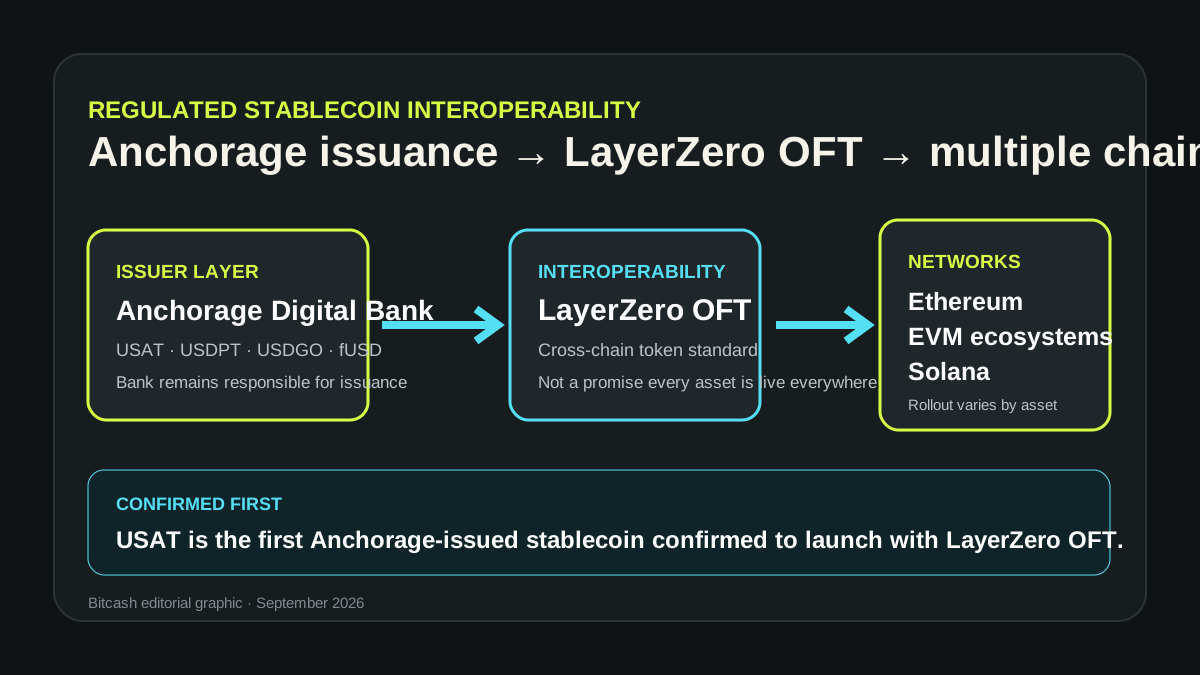
The short answer: Anchorage Digital is adding LayerZero’s OFT standard to the distribution layer for bank-issued stablecoins. Anchorage remains the issuer for supported assets; LayerZero supplies cross-chain token and messaging infrastructure. USAT is the first confirmed integration. The announcement names Ethereum, EVM-compatible ecosystems and Solana as target environments, but it does not provide a complete chain-by-chain launch schedule for every stablecoin.
What Anchorage Digital and LayerZero confirmed
Anchorage Digital announced on September 21, 2026 that LayerZero will serve as the preferred interoperability layer for stablecoins issued through Anchorage Digital Bank, N.A. The bank’s issuance platform currently supports products associated with Tether, Western Union, OSL Group and Falcon Finance, including USAT, USDPT, USDGO and fUSD.
The arrangement does not transfer issuance responsibility to LayerZero. Anchorage Digital Bank remains the regulated issuing institution for the assets it issues, while LayerZero provides the technical standard used to connect token deployments across supported blockchain networks. The Office of the Comptroller of the Currency continues to list Anchorage Digital Bank National Association among OCC-regulated institutions.
What does LayerZero OFT change?
LayerZero’s Omnichain Fungible Token standard is designed to let a fungible asset operate across multiple chains while maintaining coordinated supply accounting rather than relying on unrelated wrapped copies created by third-party bridges. In this partnership, OFT is the interoperability layer; it does not replace the stablecoin issuer, reserve framework, redemption terms or compliance controls.
That distinction is important because “cross-chain” can describe several different architectures. A user may encounter issuer-native deployments, lock-and-mint bridges, wrapped representations or burn-and-mint systems. The Anchorage announcement says stablecoins issued through the partnership will leverage OFT, but users still need to verify the official contract and supported route for the exact asset and chain they intend to use.
LayerZero says its infrastructure connects more than 170 blockchains. That network count describes the broader LayerZero ecosystem, not the number of chains on which every Anchorage-issued stablecoin is already available. Treating “170+ chains” as an immediate deployment list for USAT, USDPT, USDGO or fUSD would overstate the announcement.
Why USAT is the first confirmed stablecoin
Tether launched USAT in January 2026 as a U.S.-focused dollar-backed stablecoin issued by Anchorage Digital Bank. The September partnership announcement identifies USAT as the first stablecoin issued by Anchorage Digital Bank to launch with LayerZero interoperability using OFT.
For users, the practical change is distribution rather than a new peg or a new issuer. USAT remains a dollar-backed stablecoin issued by Anchorage Digital Bank; OFT adds a standardized way to extend the asset across supported blockchain environments. That can reduce fragmentation if deployments share one coordinated token architecture, but it does not remove issuer, smart-contract, network or operational risk.
Our stablecoin selection guide explains why issuer, backing, redemption and network support should be evaluated separately. Interoperability improves where an asset can move; it does not answer whether that asset is appropriate for a particular holder or use case.
What is not live or independently confirmed yet?
Anchorage says the partnership is intended to support stablecoins across leading ecosystems including Ethereum, EVM-compatible networks and Solana. The announcement does not publish exact activation dates, destination-chain lists or contract addresses for every stablecoin on the platform.
That means USDPT, USDGO and fUSD should not automatically be described as already live through OFT on every supported LayerZero network. The correct status is narrower: those products are part of Anchorage’s issuance platform and fall within the partnership’s stated scope, while USAT is the first asset explicitly confirmed to launch with LayerZero interoperability.
Likewise, the partnership does not mean a wallet can safely send an Anchorage-issued stablecoin to any chain that LayerZero supports. The destination must support the exact token deployment and transfer route. Sending to an unsupported network or contract can still result in loss or a difficult recovery process.
What should users and treasury teams verify?
| Check | Why it matters |
|---|---|
| Official token contract | Similar tickers and fake contracts can imitate a legitimate stablecoin deployment. |
| Supported source and destination chains | LayerZero’s overall network coverage is broader than any single stablecoin’s live deployment list. |
| Issuer and redemption terms | Interoperability does not replace the legal issuer or its redemption conditions. |
| Transfer mechanism | Confirm whether the official route uses OFT and how supply is handled between chains. |
| Wallet and platform support | An on-chain token can exist before a custodian, exchange or payment provider supports deposits and withdrawals. |
| Smart-contract and messaging risk | Cross-chain transfers add contract, endpoint and operational dependencies beyond simply holding the token. |
Before moving funds, use the issuer’s current documentation and the destination platform’s deposit page rather than assuming that matching tickers are sufficient. The stablecoin transfer checklist covers network matching, address checks and test transfers, while the risk guide separates issuer, bridge, contract and network risks.
Why this matters for institutional stablecoin infrastructure
The partnership illustrates a broader separation of roles in stablecoin infrastructure. A regulated bank can handle issuance, reserves, redemption and compliance while a blockchain interoperability provider supplies the technical layer for moving the same asset across different execution environments. That modular structure can make distribution easier without requiring the issuer to build a bespoke cross-chain system for every network.
It also creates a more complex verification task. Users must distinguish the issuer from the interoperability protocol and the destination chain. A bank-issued token can still depend on smart contracts and cross-chain messaging after issuance, so federal supervision of the issuer should not be interpreted as a guarantee against technical failure elsewhere in the stack.
For businesses considering stablecoin settlement, this is one more reason to map the full route rather than evaluating only the ticker. Our stablecoin payments guide explains the asset, network, invoice, confirmation and reconciliation layers that remain relevant even when an issuer adopts standardized interoperability.
Primary sources and verification status
Anchorage Digital, September 21, 2026 — primary announcement naming LayerZero as preferred interoperability partner, listing the stablecoin platform and identifying USAT as the first OFT integration.
LayerZero, September 21, 2026 — counterpart announcement describing the OFT standard and intended multi-chain scope.
Tether, January 27, 2026 — primary background for USAT’s launch and Anchorage Digital Bank’s issuer role.
Office of the Comptroller of the Currency — current federal institution list including Anchorage Digital Bank National Association.
For broader context, return to the stablecoin guides hub or start with how to buy stablecoin.