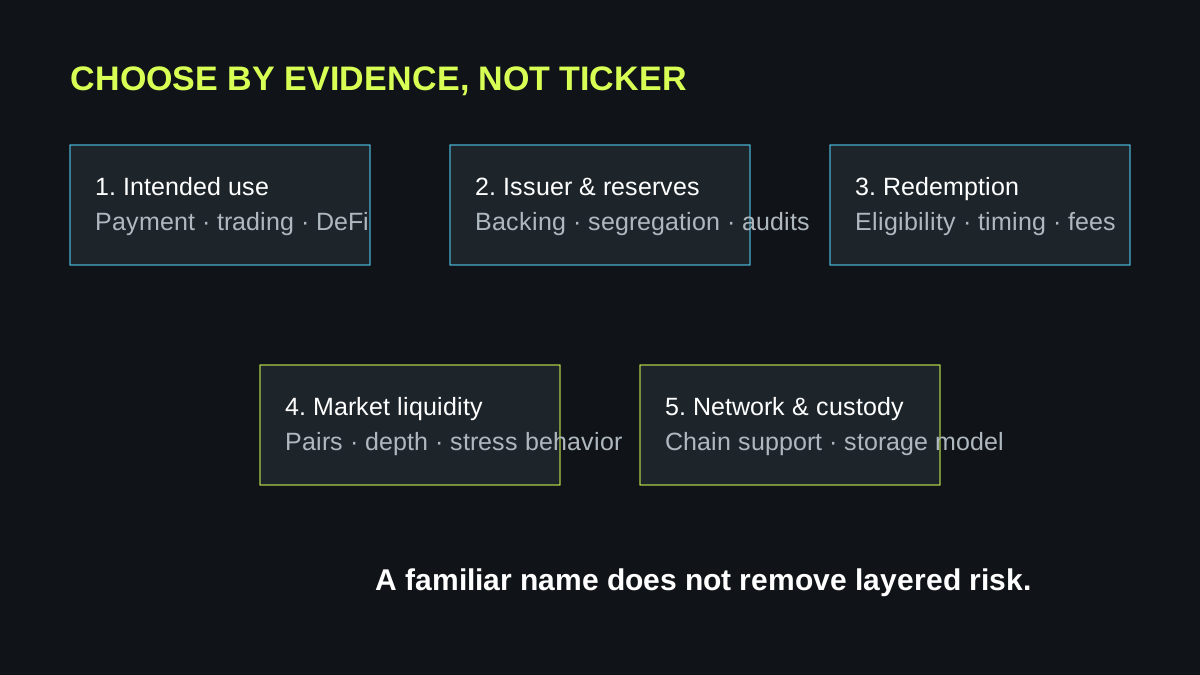
Choose a stablecoin by matching its reference asset, issuer model, reserves, redemption path, liquidity, blockchain support and custody requirements to the job you need it to perform. No single stablecoin is automatically best for every user, platform or network.
Start with the use case
The right decision begins with the task, not the ticker. A payment to a contractor may prioritise low fees and recipient support. Moving value between exchanges may prioritise liquidity and deposit compatibility. A DeFi transaction may prioritise native protocol integration while adding smart-contract risk. Temporary parking of trading proceeds may prioritise exchange availability and redemption quality.
Write down the destination, expected holding period, preferred network and whether the asset will remain with a custodian. These four facts eliminate many options before you compare brands.
Separate the three layers
Evaluate the stablecoin as three connected but distinct layers: the issuer or protocol, the backing or stabilisation mechanism, and the blockchain where the token moves. Confidence in one layer does not remove risk in the others.
Issuer or protocol
Determine who can create, redeem, freeze or govern the token. A company-issued stablecoin may depend on corporate controls, banking partners and legal claims. A decentralised design may depend on collateral rules, liquidation systems, governance and oracles.
Backing and redemption
Look for the assets or mechanisms supporting the peg, how frequently they are disclosed, who holds them and who can redeem directly. Retail holders may rely on exchange liquidity even when institutional customers can redeem with the issuer.
Blockchain implementation
The same ticker may exist on several networks. Each version can have different fees, wallet support, smart-contract exposure and exchange compatibility. Native and bridged versions are not necessarily equivalent.
Questions to ask before choosing
- What value is the coin designed to track?
- Who issues or governs it?
- What supports the peg?
- Who can redeem directly and under what conditions?
- How current and specific are reserve disclosures?
- Where is meaningful market liquidity available?
- Which networks support the exact token contract?
- Can the sender, recipient and intended wallet all use the same network?
- Can transfers be frozen or addresses blocked?
- What additional risks appear if the token is bridged or deposited into a protocol?
Compare liquidity, not only market size
A large market value does not guarantee easy execution everywhere. Review liquidity on the platform you actually intend to use, the size of the order, the spread and the withdrawal route. A token can be liquid on one exchange and inconvenient on another.
For payment use, recipient acceptance matters more than broad popularity. Confirm the exact token and chain before purchase rather than assuming the recipient can receive every version.
Assess custody and control
Holding on an exchange is operationally simple, but the platform controls the private keys and may restrict withdrawals. Self-custody gives the holder control of the keys, but it also transfers responsibility for backups, device security, transaction verification and recovery.
Neither model is universally safer. The better choice depends on the amount, holding period, technical ability and consequences of losing either account access or a recovery phrase.
Do not treat yield as a stablecoin feature
A yield offer normally introduces another layer such as lending, staking, liquidity provision, a centralised counterparty or a smart contract. Evaluate that layer separately. A stable token does not make the yield mechanism low risk.
Warning signs
- Unclear or stale reserve information.
- Redemption terms that are difficult to locate or understand.
- Heavy reliance on one exchange, custodian or bridge.
- A high yield presented without a clear source of return.
- Ambiguous contract addresses or unofficial token listings.
- Marketing that treats the peg as guaranteed.
A practical decision process
- Define the exact job and destination.
- List the networks supported by both sides.
- Compare issuer, backing and redemption.
- Check liquidity and full transaction cost.
- Choose custody based on your operational ability.
- Test a new route with a small amount.
Continue with the stablecoin risk guide, review the transfer checklist, or return to the complete how to buy stablecoin guide.