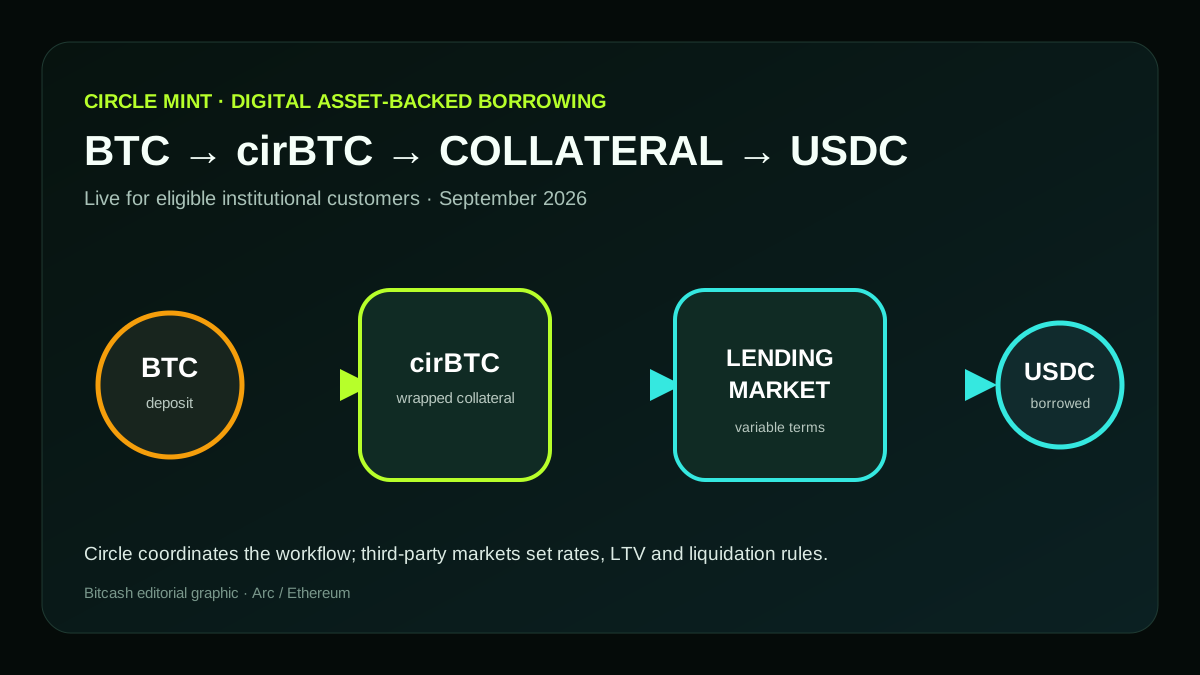
The short answer: Circle Mint now coordinates a Bitcoin-to-USDC borrowing workflow for eligible customers, but Circle is not itself promising a fixed loan or eliminating DeFi risk. BTC is converted into Circle Wrapped Bitcoin (cirBTC), cirBTC is supplied to a supported third-party lending market, and USDC is borrowed against that collateral. Rates, loan-to-value limits, liquidation thresholds and available liquidity come from the lending market and can change.
What Circle launched on September 21
Circle says Digital Asset-Backed Borrowing, or DABB, is now available to eligible Circle Mint LLC customers on Arc and Ethereum. The product connects several steps that institutions previously had to coordinate separately: depositing Bitcoin, minting cirBTC, supplying collateral to a lending protocol and receiving borrowed USDC back in Circle Mint.
The important distinction is that this is a live product announcement, not a roadmap item. Circle's September 21 announcement describes DABB as available now to eligible customers. Independent reporting on September 22 likewise describes the service as launched rather than planned.
How Bitcoin becomes USDC liquidity
An eligible Circle Mint customer starts with Bitcoin rather than selling it for dollars or stablecoins.
Circle coordinates conversion into Circle Wrapped Bitcoin, the tokenized BTC representation used as on-chain collateral.
The cirBTC is supplied through a wallet controlled by the customer to a supported third-party lending market on Arc or Ethereum.
The lending market creates the collateralized debt position and the borrowed USDC can be received in Circle Mint.
This matters operationally because an institution can obtain dollar-denominated on-chain liquidity while retaining economic exposure to Bitcoin. But “without selling BTC” does not mean “without cost”: the borrower pays a variable borrowing rate and accepts liquidation risk if collateral value falls or protocol parameters change.
Is Circle lending the USDC?
Not in the ordinary sense of Circle underwriting a bilateral loan. Circle's own announcement repeatedly describes the borrowing as occurring through supported third-party lending markets. Independent coverage identifies Morpho markets as part of the current infrastructure.
That separation matters for risk analysis. Circle Mint simplifies the workflow and cirBTC provides the collateral representation, but the lending protocol governs the on-chain position. A borrower should therefore review both Circle's product terms and the specific market's smart contracts, oracle design, collateral parameters and liquidity.
The product also should not be confused with a yield account. Borrowing USDC creates a debt position secured by cirBTC; it does not generate a guaranteed return on Bitcoin.
What are the main risks?
| Risk | What to check |
|---|---|
| Bitcoin price risk | A falling BTC/cirBTC collateral value can move the position toward liquidation. |
| Liquidation risk | Review the live loan-to-value and liquidation threshold before borrowing. |
| Variable-rate risk | Borrowing costs can change with utilization and market conditions. |
| Smart-contract risk | The lending market and connected contracts can fail or behave unexpectedly. |
| Oracle risk | Collateral valuation depends on price data used by the lending protocol. |
| Wrapped-asset risk | cirBTC adds issuer, custody, minting/redemption and token-contract dependencies beyond native BTC. |
| Liquidity risk | Available USDC and the cost of borrowing can change as suppliers enter or leave the market. |
The structure is therefore different from simply holding USDC. Our stablecoin risk guide explains issuer, smart-contract, network and custody layers; this borrowing product adds collateral and liquidation risk on top.
Who can use Circle's Bitcoin-backed borrowing?
Circle describes DABB as available to eligible Circle Mint LLC customers, so it should not be presented as a retail borrowing feature available to every wallet holder. Eligibility, jurisdiction and onboarding requirements can restrict access.
The current announcement names Arc and Ethereum. Users should not assume the same workflow exists on another chain merely because cirBTC or USDC is available there. Product availability and supported lending markets should be checked in Circle Mint at the time of use.
For treasury teams, the useful comparison is not simply “sell BTC or borrow.” Borrowing preserves Bitcoin exposure but creates interest expense, liquidation risk and protocol exposure. Selling removes the collateralized debt risk but also ends the Bitcoin position and can have accounting or tax consequences depending on jurisdiction.
Why this is a separate stablecoin use case
Stablecoins are often discussed as payment or settlement assets. Here, USDC is the borrowed liquidity leg of a collateralized financing workflow. That makes the product closer to on-chain secured credit than to the payment flow described in our stablecoin payments guide.
It also illustrates why tokenized assets and stablecoins increasingly interact in the same transaction stack: native BTC becomes cirBTC collateral, a lending protocol evaluates that collateral, and USDC becomes the transferable liability received by the borrower. Each layer has a different issuer, contract and risk model.
Sources and verification status
Circle, September 21, 2026 — primary launch announcement for DABB, eligible Circle Mint LLC customers, Arc/Ethereum availability and the BTC → cirBTC → lending market → USDC workflow.
Crypto.news, September 22, 2026 — independent confirmation of the launch and institutional positioning.
The Defiant, September 22, 2026 — independent coverage of the Morpho lending-market implementation and variable market conditions.
For related operational context, see how to choose a stablecoin, the transfer checklist, or return to the stablecoin guides hub.