The short answer: HKDAP is designed to represent one Hong Kong dollar per token, with reserve assets required to cover at least the par value of HKDAP in circulation. It runs on Ethereum during the Beta phase and can be redeemed 1:1 for HKD through the distribution framework. The important limitation is access: the August 2026 rollout is phased, not a universal retail launch, and users should verify the official contract and distributor route before interacting with any token claiming to be HKDAP.
What changed in August 2026
On August 12, Reuters reported that Anchorpoint Financial had begun the first phase of the HKDAP rollout. The initial model gives institutional distributors and professional users a way to integrate the token into commercial and financial applications, including payment and settlement use cases. Anchorpoint has described a broader business-to-business-to-consumer model in which authorised distributors become the main access layer for end users.
This is a different milestone from the licence itself. The HKMA granted Anchorpoint stablecoin issuer licence FRS01 on April 10, 2026. Before commercial rollout, Anchorpoint and partners completed Ethereum-mainnet test transfers in May, covering fiat funding, reserve backing, minting, transfer and redemption. Those tests were fully redeemed afterward, so they should not be confused with the later phased product rollout.
How HKDAP is designed to work
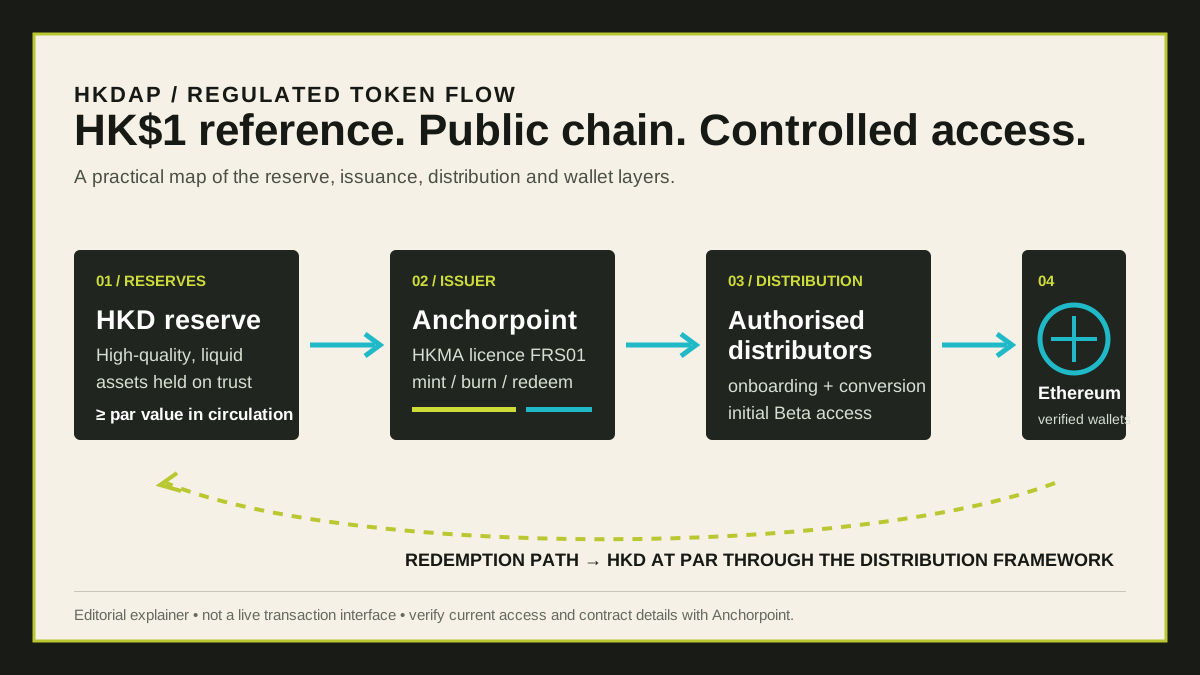
Anchorpoint defines HKDAP as a fiat-referenced stablecoin with a par value of HK$1.00. Its whitepaper says the market value of the reserve pool must be at least equal to the par value of HKDAP in circulation, with reserve assets held on trust for token holders. Anchorpoint’s public product material describes those reserves as high-quality and highly liquid rather than as a promise that the token is risk-free.
The operating model separates issuance from broad distribution. Anchorpoint directly onboards authorised distributors, while most businesses and users access or convert HKDAP through those distributors. When new HKDAP is issued, the system is intended to pair the token supply with the required reserve funding. Redemption reverses the process: eligible holders use the distribution and redemption channels to convert HKDAP back to Hong Kong dollars at par.
| Layer | What it does | What to verify |
|---|---|---|
| Reference value | Targets HK$1.00 per HKDAP | Par-value and redemption terms |
| Reserve layer | Backs circulating HKDAP with eligible reserve assets | Reserve disclosures, trust structure and attestations |
| Issuer | Anchorpoint Financial, licence FRS01 | HKMA register and official Anchorpoint domain |
| Distribution | Authorised distributors provide access and fiat conversion | Whether the provider is actually named or authorised |
| Blockchain | Ethereum mainnet during Beta | Exact contract address and wallet eligibility |
This structure is useful to separate from a normal bank deposit. A stablecoin is a token with issuer, reserve, smart-contract, distribution and blockchain dependencies. Even when regulation strengthens the framework, the user still needs to understand each layer rather than treating the ticker as equivalent to cash sitting in a bank account.
Who can access HKDAP now?
The answer depends on the launch phase and the service provider. Anchorpoint’s published FAQ says Beta access is for corporates and Professional Investors, with a later full launch intended to expand coverage to retail individuals. Reuters’ August 12 report likewise describes the initial rollout as limited to institutional distributors and professional investors, with broader retail adoption targeted later in 2026 subject to market conditions.
Most end users do not open a direct Anchorpoint account. Anchorpoint says only authorised distributors have a direct account relationship with the issuer; other users access HKDAP through a distributor’s own account-opening and compliance process. That means availability, onboarding, fiat conversion, withdrawals and wallet support can differ by provider and jurisdiction.
For a reader comparing stablecoins, this access model matters as much as the peg. A token can be technically transferable on a public blockchain while still having regulated onboarding, wallet-verification and distribution requirements around it. Our guide to choosing a stablecoin explains why issuer, redemption and access rules should be checked separately from liquidity and network support.
Ethereum, the official contract and wallet controls
Anchorpoint’s current FAQ says HKDAP is available on Ethereum mainnet during the Beta phase. The official contract address published there is 0x87622385F960fcCB3121d6D0A9513bd1D9Bed6cA. This detail is especially important because the HKMA and Anchorpoint previously warned about unrelated tokens using the HKDAP name or ticker before the regulated token became available.
Do not identify a token by name, logo or ticker alone. Verify the contract against Anchorpoint’s current official material, then confirm that the distributor or wallet workflow you are using supports the same contract and network. A search result, social post or wallet token list can be copied or spoofed.
HKDAP also differs from a completely permissionless ERC-20 transfer model. Anchorpoint says wallet ownership verification and whitelisting can apply when users withdraw to their own wallets, and its FAQ states that transfers to unverified wallets are rejected by compliance controls embedded in the token system. Users therefore need to check both blockchain compatibility and the eligibility status of the wallet address.
What risks remain with a regulated stablecoin?
Regulation does not remove every failure mode. HKDAP still depends on reserve management, redemption operations, smart contracts, Ethereum, authorised distributors, custodial and banking relationships, compliance controls and the security of each user’s account or wallet. A licence changes the supervisory framework; it does not convert a blockchain token into a government-guaranteed bank balance.
- Reserve and redemption risk: users depend on the reserve structure and functioning redemption channels.
- Distribution risk: access and fiat conversion may depend on an authorised intermediary whose service can have limits or outages.
- Smart-contract risk: code governs token operations and compliance functions; software and administrative controls can fail.
- Network risk: Ethereum fees, congestion or chain-level incidents can affect transfers.
- Compliance and wallet risk: whitelisting or verification rules can prevent a transfer even when the address is technically valid.
- Jurisdiction risk: access outside Hong Kong depends on local law and the distributor’s policies.
- Impersonation risk: fake tokens can copy the ticker and branding while using a different contract.
These are layers to evaluate, not reasons to assume failure. Our broader stablecoin risk guide explains how reserve, custody, smart-contract, bridge and operational risks differ across designs.
How HKDAP differs from a typical dollar stablecoin
The first difference is the reference currency: HKDAP is designed around the Hong Kong dollar rather than the US dollar. The second is the regulatory and distribution model. It is issued under Hong Kong’s Stablecoins Ordinance by an HKMA-licensed issuer, and the initial access path relies on authorised distributors and verified users rather than broad anonymous retail distribution.
The third difference is practical use. Anchorpoint positions HKDAP as tokenized money for payments, settlement, treasury and tokenized-market infrastructure. It is not described as a yield-bearing investment product. That means the central user question is less “what return does it pay?” and more “does this HKD-denominated settlement rail fit the transaction, jurisdiction, counterparty and network I need?”
| Question | HKDAP |
|---|---|
| Reference currency | Hong Kong dollar |
| Issuer | Anchorpoint Financial Limited |
| Issuer licence | HKMA stablecoin issuer licence FRS01 |
| Initial blockchain | Ethereum mainnet |
| Retail access | Not broad in the initial Beta phase; expansion planned after Beta |
| Yield | Not designed as a yield-bearing product |
What a user should check before using HKDAP
- Confirm the current launch phase and your eligibility on Anchorpoint’s official site.
- Use an authorised distributor or another officially supported access route.
- Verify the exact Ethereum contract address from the issuer before acquiring or transferring the token.
- Confirm whether the destination wallet must be verified or whitelisted.
- Read the distributor’s fiat conversion, redemption, fee and withdrawal terms.
- Check whether your jurisdiction permits the service and token use.
- For a new route, use the same careful address-and-network process described in our stablecoin transfer checklist.
For readers who are new to the asset class, the main how to buy stablecoin guide provides the wider framework: identify the exact asset, issuer, network, access provider, storage model and total cost before moving money.
Sources and status references
Reuters, August 12, 2026 — first-phase rollout, initial audience and retail target context.
Anchorpoint HKDAP FAQ — launch phases, eligibility, official Ethereum contract and wallet-verification rules.
Anchorpoint HKDAP whitepaper — issuer details, reserves, distribution, Ethereum and redemption architecture.
Hong Kong Monetary Authority licence announcement, April 10, 2026 — official licence status.
OSL and Anchorpoint, May 13, 2026 — Ethereum mainnet lifecycle test before commercial rollout.
HKMA public warning, April 28, 2026 — warning about unrelated tokens using licensed-stablecoin names.