The short answer: Singapore is moving its stablecoin framework from policy into proposed legislation, while revisiting some positions set in 2023. The draft would create a dedicated licensing path for qualifying single-currency stablecoin issuers, preserve the core reserve, redemption, capital and disclosure safeguards, add new issuer obligations, and potentially recognize a limited number of foreign-issued stablecoins regulated under comparable overseas frameworks. MAS has not announced a final implementation date.
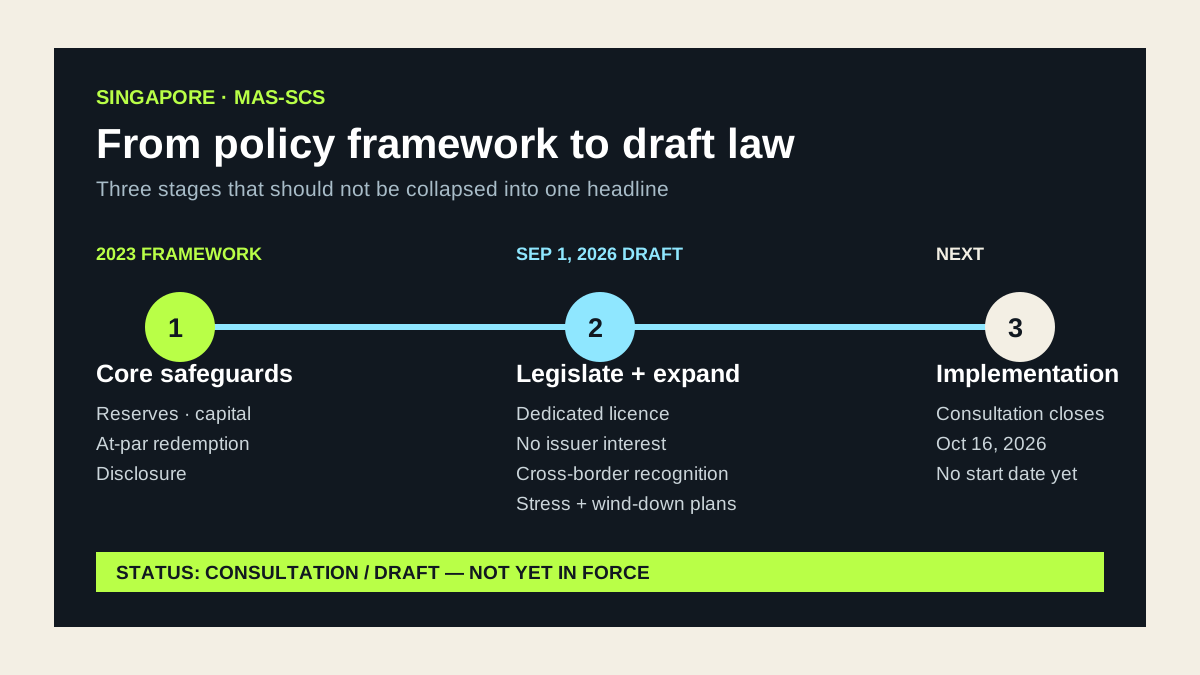
What happened on September 1, 2026?
MAS published a consultation on proposed amendments to the Payment Services Act 2019 to implement the MAS Single-Currency Stablecoin framework. The consultation is identified as P015-2026 and remains open until October 16, 2026.
The distinction between proposal and law matters. MAS finalized the policy framework in 2023, but the September 2026 paper is the legislative implementation stage. The draft can still change after consultation, and MAS says it will consult separately on subsidiary legislation later.
Which requirements come from the 2023 stablecoin framework?
Several protections being discussed in 2026 are not new ideas. MAS finalized the core framework in August 2023 for single-currency stablecoins pegged to the Singapore dollar or a G10 currency and issued in Singapore.
That earlier framework established the main value-stability safeguards: reserve backing, capital requirements, redemption at par and disclosure obligations. MAS said reserve assets should be low-risk and highly liquid, and qualifying issuers would be able to use the label “MAS-regulated stablecoin.” Stablecoins outside that framework would continue to be treated under Singapore's broader digital payment token rules.
This is important for searchers comparing headlines. The 2026 consultation is not a completely new stablecoin regime written from scratch. It is a legislative implementation of the 2023 framework plus additional policy proposals.
What is newly proposed in 2026?
The September consultation adds several details beyond simply putting the 2023 framework into legislation. Reporting on the consultation and legal analysis of the draft identify a dedicated stablecoin issuance licensing structure, a proposed prohibition on issuer-paid interest or benefits calculated by reference to a holder's stablecoin balance, and additional resilience requirements.
The consultation also proposes stress testing and recovery or orderly wind-down planning for regulated issuers. These requirements are designed to test whether an issuer can continue meeting obligations under financial or operational stress rather than treating reserve backing as the only relevant safeguard.
Some secondary coverage also highlights operational controls for tracing, freezing or burning tokens associated with illicit activity. Because final technical rules and subsidiary legislation are still pending, those implementation details should be treated as proposed requirements rather than final operating standards.
| Area | 2023 framework | September 2026 proposal |
|---|---|---|
| Reserve backing | Core safeguard already established | Would be implemented through legislation |
| Redemption | At-par redemption requirement | Would become part of the statutory regime |
| Issuer licensing | Policy framework defined qualifying issuers | Dedicated legislative licensing structure proposed |
| Interest to holders | Not the headline feature of the 2023 framework | Issuer-paid interest or balance-linked benefits proposed to be prohibited |
| Stress and wind-down planning | Not a central public feature of the 2023 framework | Additional stress-testing and recovery requirements proposed |
| Foreign-issued stablecoins | Framework focused on Singapore issuance | Limited recognition under comparable overseas regimes is being considered |
Could foreign-issued stablecoins become MAS-regulated stablecoins?
Potentially, but not automatically. One of the most notable 2026 proposals is to consider recognizing a limited number of foreign-issued stablecoins that are supervised under regulatory frameworks MAS considers comparable.
MAS is also reconsidering how multi-jurisdictional issuance could fit the framework. Legal analysis of the consultation notes that jointly issued stablecoins involving a Singapore issuer and a foreign issuer could become eligible if the associated risks are sufficiently mitigated.
No public final whitelist exists yet. It would therefore be inaccurate to say that a specific token such as USDC or USDT has already received recognition under the proposed system. The relevant future facts will be the final comparability criteria, the jurisdictions MAS accepts and the specific issuers or tokens that meet those conditions.
What would this mean for stablecoin users and businesses?
For users, the practical benefit of a regulated label would be a clearer framework for evaluating issuer obligations around reserves, redemption and governance. It would not remove every stablecoin risk. Network congestion, smart-contract risk, custody failure, wallet mistakes and service-provider limits can still matter even when the issuer is regulated.
For businesses accepting stablecoins, regulation is only one part of the operational decision. They still need to verify which token and network are supported, how assets are converted or held, how redemption works and who bears compliance and custody responsibilities. The stablecoin payment guide covers those operational checks.
Users comparing products should also separate an issuer's regulatory status from token selection. Our guide to choosing a stablecoin explains how reserves, redemption, liquidity, network support and custody fit together, while the stablecoin risk guide covers the layers that regulation does not eliminate.
What happens next?
- Consultation remains open. MAS is accepting comments until October 16, 2026.
- MAS reviews feedback. The draft provisions may change before finalization.
- Further subsidiary legislation is expected. MAS has indicated that additional consultation will follow.
- Implementation date still needs confirmation. No final start date should be assumed until MAS publishes it.
- Foreign-recognition details remain open. Comparable-regime criteria and any recognized foreign issuers or tokens still need to be published.
The useful takeaway today is precise: Singapore has proposed the legislative machinery for its long-planned stablecoin framework and opened the door to broader cross-border recognition, but the September 2026 package is still a consultation rather than a live final regime.
Sources and status references
Monetary Authority of Singapore, September 1, 2026 — official announcement of the consultation and legislative implementation step.
MAS consultation P015-2026 — primary consultation document and draft legislative proposals.
MAS, August 15, 2023 — official baseline for the earlier stablecoin framework.
Gibson Dunn, September 1, 2026 — independent legal analysis distinguishing the 2023 framework from the 2026 draft and highlighting cross-border changes.
For the broader learning path, return to the stablecoin guides hub.