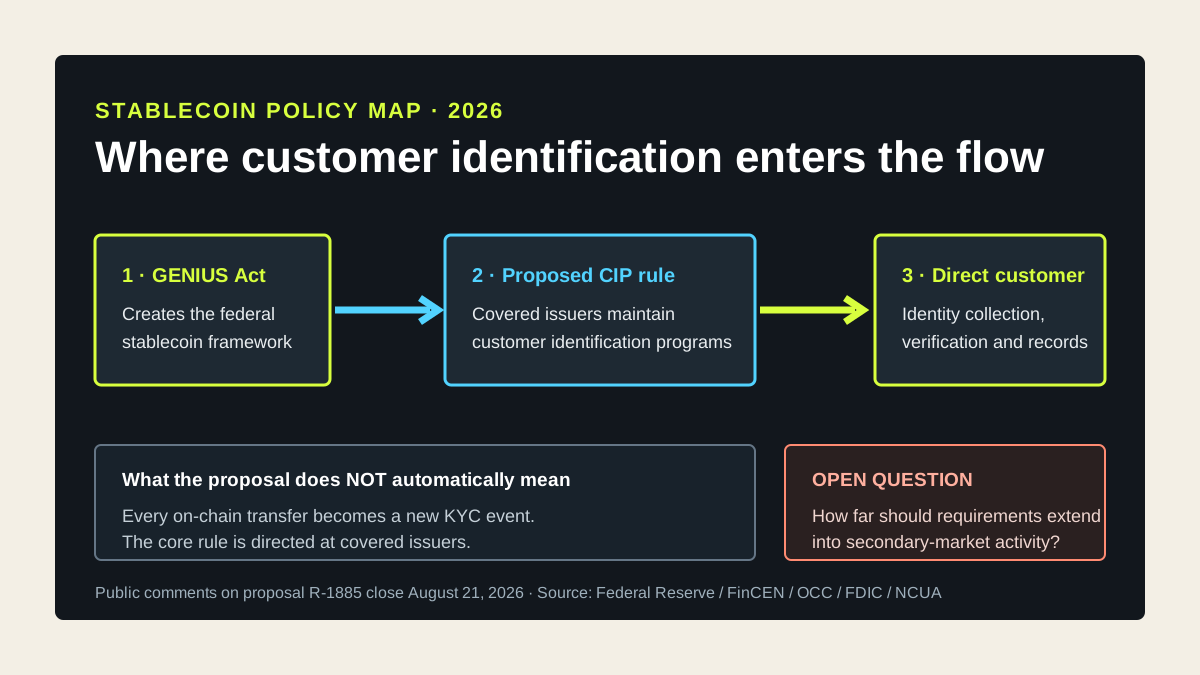
The short answer: the proposal would require permitted payment stablecoin issuers to maintain an effective customer identification program, broadly comparable to the customer identification requirements applied to banks and credit unions. It does not mean every stablecoin transfer would automatically require a new identity check, and it is not yet a final rule. The important distinction is between obligations imposed on regulated issuers and the broader secondary-market activity that can occur after tokens are issued.
What happened
On June 18, 2026, the Federal Reserve, FinCEN, the Office of the Comptroller of the Currency, the Federal Deposit Insurance Corporation and the National Credit Union Administration jointly requested comment on a proposed rule for permitted payment stablecoin issuers. The proposal implements GENIUS Act directives that treat covered issuers as financial institutions under the Bank Secrecy Act and require them to maintain an effective customer identification program, commonly shortened to CIP.
The Federal Reserve proposal page lists August 21, 2026 as the closing date for comments. That listed comment period has now passed. As of August 24, 2026, the Federal Reserve still identifies R-1885 as a rulemaking proposal rather than a final rule, so the next step is to watch the regulatory record for any revision, final rule or other agency action.
Who the proposal is aimed at
The rulemaking is aimed at permitted payment stablecoin issuers, a regulated category created by the GENIUS Act. In practical terms, the proposal is about the compliance obligations of issuers that fall inside the federal stablecoin framework. It is not a blanket statement that every wallet provider, decentralized exchange, blockchain validator or peer-to-peer recipient becomes a stablecoin issuer.
The OCC has separately explained that GENIUS Act rules can apply to several categories of entities under its jurisdiction, including certain bank subsidiaries, federal qualified payment stablecoin issuers, some state qualified issuers and foreign payment stablecoin issuers where the statute gives the OCC regulatory authority. Which regulator applies can depend on the issuer's legal form and supervisory status.
What a customer identification program actually means
A CIP is a formal process for establishing a reasonable belief that an institution knows the true identity of a customer. In the banking context, that normally means collecting identifying information, verifying it using documentary or non-documentary methods, keeping required records and handling cases where identity cannot be satisfactorily verified.
The stablecoin proposal matters because it moves issuer identity controls from a general compliance expectation toward a dedicated rule specifically tied to the GENIUS Act. For users, that could make identity checks more standardized when dealing directly with a covered issuer or with products that depend on issuer onboarding and redemption.
| Question | What the proposal indicates |
|---|---|
| Is identity verification part of the framework? | Yes. Covered issuers would need an effective customer identification program. |
| Is the rule final? | No. The listed comment period closed August 21, 2026, but R-1885 remains identified as a rulemaking proposal. |
| Does every on-chain transfer become a KYC event? | The proposal does not establish that broad conclusion. Its core requirement is directed at covered issuers. |
| Are secondary-market transactions fully resolved? | No. Regulators have explicitly raised questions about risks beyond direct issuer relationships. |
The unresolved issue: secondary-market stablecoin activity
One of the most important limits of the proposal is what happens after a stablecoin moves beyond the issuer's direct customer relationship. Governor Michael Barr's statement supporting the proposal specifically notes concern about illicit-finance risks in secondary-market stablecoin transactions and says he will review comments on whether portions of the CIP framework should extend further into that activity.
This distinction matters for understanding how stablecoins actually circulate. A token can be issued through a regulated entity and later move through exchanges, self-custody wallets, decentralized protocols, payment flows and other on-chain routes. An issuer-side CIP can identify the issuer's customer, but that does not automatically identify every later holder or every counterparty in a permissionless transfer.
That is why it would be misleading to summarize the proposal as “KYC for every stablecoin wallet.” The more accurate description is that regulators are formalizing identity-program requirements for permitted issuers while still evaluating how the broader transaction lifecycle should be treated.
What stablecoin users may notice if a similar rule becomes final
The first visible effect would most likely be at onboarding, issuance and redemption touchpoints rather than at the blockchain protocol layer itself. Users interacting directly with a covered issuer could encounter more standardized identity collection, verification and recordkeeping processes. Services that integrate directly with issuers may also need to align their customer flows with the issuer's compliance requirements.
- Direct issuer accounts: identity verification may become more explicitly standardized under a dedicated stablecoin CIP rule.
- Redemption workflows: access to direct redemption may depend on an issuer's customer and compliance processes.
- Exchange purchases: many regulated exchanges already perform identity checks, so the practical change could be smaller for users already inside those systems.
- Self-custody transfers: the proposal does not itself convert a normal blockchain transfer into an issuer onboarding event.
- DeFi usage: protocol-level interaction and issuer compliance remain different layers, although future rules could affect gateways between them.
For someone learning how to buy stablecoin, the practical lesson is to separate the asset layer from the access layer. The token may move on a public blockchain, while the company issuing or redeeming it can still have regulated customer-identification obligations.
How this fits with other 2026 GENIUS Act rulemaking
The CIP proposal is only one part of the broader implementation process. Treasury and other regulators have also worked on anti-money-laundering, sanctions, reserve, capital, custody and redemption requirements for permitted issuers. The FDIC, for example, proposed rules addressing reserve assets, risk management, custody and redemption standards for entities under its supervision.
That broader context is important because “stablecoin regulation” is not one rule. Different proposals address different layers: who may issue, what reserves must look like, how redemption works, what compliance controls apply and how customers are identified. A useful review therefore asks which rule is being discussed rather than treating every regulatory headline as interchangeable.
Key dates and what to watch next
| Date | Event |
|---|---|
| July 18, 2025 | GENIUS Act enactment date referenced by regulators. |
| June 18, 2026 | Federal agencies announced the proposed stablecoin CIP rule. |
| August 21, 2026 | Listed closing date for public comments on proposal R-1885; that date has passed. |
| After comment review | Agencies may revise, finalize or otherwise continue the rulemaking process. |
The next meaningful milestone is the regulatory record after the comment period: watch for changes to scope, verification expectations, treatment of secondary-market activity, implementation timing and coordination with other GENIUS Act rules.
Practical takeaway
The 2026 CIP proposal is significant because it makes customer identification a specific implementation issue for permitted payment stablecoin issuers. It should not be overstated into a claim that every stablecoin transfer or self-custody wallet is becoming subject to a new identity check. For users, the likely compliance impact is strongest where they interact directly with regulated issuers, exchanges or redemption gateways.
Before choosing a stablecoin, also review our guides to choosing a stablecoin, stablecoin risks and sending stablecoins safely. Those decisions remain separate from the regulatory question of how a covered issuer identifies its customers.
Primary sources
Federal Reserve proposal R-1885 — official proposal details and August 21, 2026 comment deadline.
Federal Reserve press release, June 18, 2026 — summary of the joint CIP proposal.
Governor Michael S. Barr statement — discussion of secondary-market concerns.
OCC GENIUS Act regulations bulletin — issuer categories and implementation context.
FDIC GENIUS Act proposal summary — reserve, redemption, custody and supervisory context.