The short answer: a national trust bank charter can place specified stablecoin and custody activities inside a federally supervised OCC-chartered institution, but the exact permissions depend on the approved business plan and conditions. In the World Liberty Trust Company case, Reuters and the Financial Times report that the OCC granted preliminary conditional approval for a proposed national trust bank tied to USD1 issuance and digital-asset custody. They also report that the proposed trust bank would not operate like a normal consumer bank that accepts deposits and makes loans.
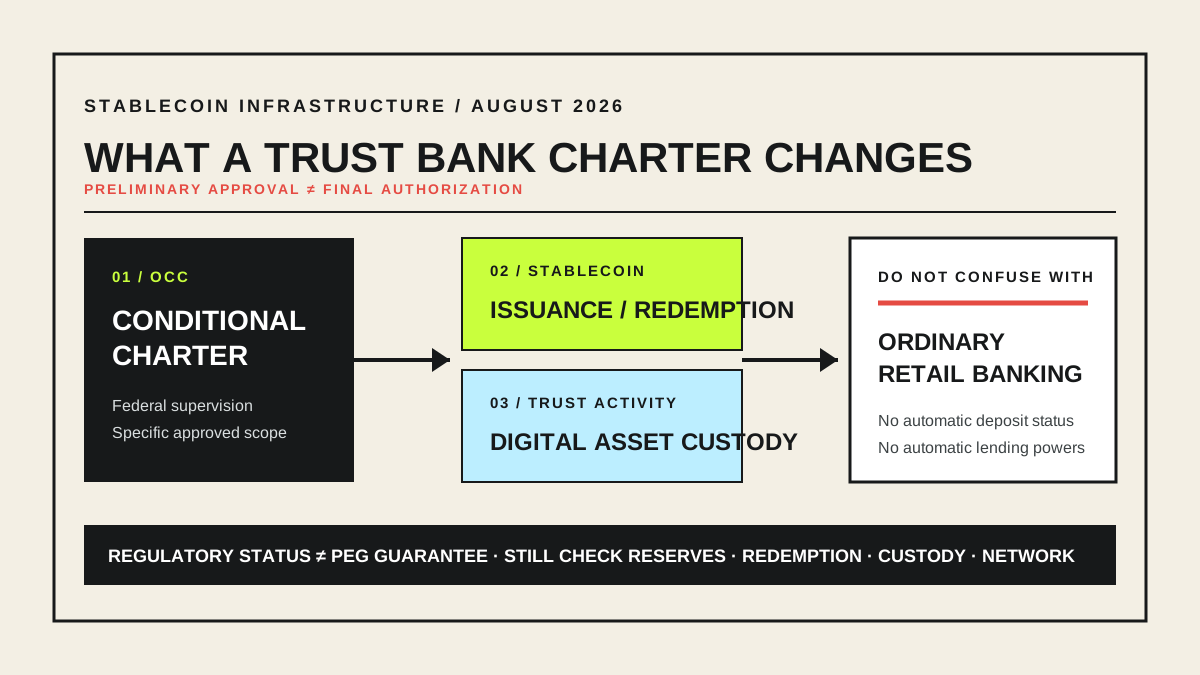
What did the OCC approve on August 14, 2026?
The Office of the Comptroller of the Currency lists Corporate Decision 1385, dated August 14, 2026, as an application to charter World Liberty Trust Company, National Association, in Bay Harbor Islands, Florida. The OCC's public index therefore confirms that a formal charter decision exists and identifies the proposed institution and decision date.
Reuters and the Financial Times describe the decision as preliminary conditional approval. That wording matters. It means the application passed an important chartering stage, but it should not be described as an unconditional final authorization to begin business. Both reports say the trust company must satisfy regulatory requirements before the charter process is complete.
The same reports connect the proposed trust bank to World Liberty Financial's USD1 stablecoin. Reuters says the structure is intended to support stablecoin issuance and management and digital-asset custody under federal supervision. The Financial Times likewise reports that the proposed trust bank would be able to issue dollar-backed stablecoins and offer digital-asset custody, while not being permitted to take ordinary deposits or make loans like a conventional commercial bank.
What can a national trust bank charter change for a stablecoin issuer?
For a stablecoin business, the practical significance is not the word “bank” by itself. The significance is that defined activities can be performed by a federally chartered and OCC-supervised entity rather than solely through a patchwork of separate state-level structures and third-party service providers.
That can affect the operating model in several ways. A chartered trust entity can have direct regulatory obligations around governance, capital, compliance, risk management, custody and the activities specifically approved by the OCC. It can also change which functions are performed inside the issuer's own regulated entity instead of being outsourced.
But a charter does not create a blank check. The OCC approves a specific application and business plan, and the institution remains subject to the conditions attached to that approval. A reader should therefore ask what the charter actually authorizes rather than assuming that every national trust bank has identical powers.
| Question | World Liberty Trust Company example | Why it matters |
|---|---|---|
| Regulator | Office of the Comptroller of the Currency | The proposed institution would operate under a federal banking supervisor. |
| Approval status | Preliminary / conditional | Final authorization is a separate step; the institution should not be treated as fully operational solely because of the August decision. |
| Reported stablecoin role | USD1 issuance and management | Stablecoin functions can sit inside the chartered entity's approved scope. |
| Reported custody role | Digital-asset custody | Custody can be a regulated trust activity rather than merely an external vendor relationship. |
| Ordinary deposits and lending | Reuters and FT report these are not part of the model | “National trust bank” should not be confused with a normal retail checking-and-lending bank. |
What does a trust-bank charter not prove?
The charter headline does not answer every question a stablecoin holder should care about. Most importantly, regulatory status and token risk are related but not identical.
- It does not make the stablecoin a bank deposit. A token issued by a regulated entity is still a digital asset with its own redemption, reserve, network, contract and custody mechanics.
- It does not guarantee the peg. Market liquidity, redemption access, reserve quality and operational execution still matter.
- It does not eliminate blockchain risk. A holder can still lose money or access through wrong-network transfers, compromised wallets, smart-contract problems, bridges or platform failures.
- It does not mean the charter is final. In this case, the August 14 approval is preliminary and conditional.
- It does not imply every trust-bank stablecoin structure is the same. The OCC authorizes particular activities and conditions for a particular institution.
This is why a regulatory headline should be one input in a broader assessment, not a substitute for the stablecoin risk checklist.
Why is the distinction between a trust bank and a commercial bank important?
The word “bank” can create the wrong mental model. A conventional commercial bank typically combines deposit accounts, payments, lending and other banking services. A national trust bank can be much narrower, with activities built around custody, fiduciary or related approved functions.
In the World Liberty case, Reuters and the Financial Times explicitly report that the proposed entity would not accept ordinary deposits or make loans. That is a useful guardrail for searchers asking whether USD1 is “becoming a bank account.” The answer is no: the reported charter structure concerns the institution providing the stablecoin and custody functions, not conversion of USD1 balances into ordinary insured checking deposits.
The correct comparison is therefore not “stablecoin versus bank account because both now have a bank charter.” It is “stablecoin issued or managed through an OCC-supervised trust entity versus a stablecoin whose issuer uses a different regulatory and operating structure.”
What should a stablecoin user check after a charter announcement?
A useful review starts with the legal entity and then moves outward to the token. If the charter ultimately becomes effective, users should identify which entity actually issues the token, which entity holds or manages reserves, who can redeem directly, and whether the custody and redemption process described in official terms matches the headline.
- Check the approval status. Is the charter preliminary, conditional or final?
- Identify the issuing entity. Do not assume the brand name and the legally responsible issuer are identical.
- Read the redemption terms. Determine who can redeem directly, minimums, settlement timing and eligibility.
- Review reserve disclosures. A charter does not replace evidence about reserve composition, custody and liquidity.
- Confirm the token contract and network. Federal supervision of an issuer does not protect against sending the wrong asset on the wrong chain.
- Separate issuer custody from your custody. Holding a token on an exchange, in a hosted wallet or in self-custody adds a separate operational layer.
For transfer-level checks, use the stablecoin transfer checklist. For issuer selection, the stablecoin selection guide separates issuer, backing, redemption, liquidity, network and custody instead of reducing the decision to one regulatory label.
How should you compare a chartered stablecoin issuer with another issuer?
Do not rank issuers by charter label alone. A better comparison uses the same questions across every token: who is legally responsible, what reserves support the liability, where those reserves are held, how often disclosures are published, who can redeem, what fees or minimums apply, which networks are supported and what happens if the user cannot redeem directly.
| Comparison dimension | What to verify |
|---|---|
| Regulatory entity | Exact issuer or trust company, regulator, charter/license status and whether approval is final. |
| Reserves | Asset composition, custodian, liquidity and current disclosure date. |
| Redemption | Eligible customers, minimums, timing and fees. |
| Custody | Who controls reserve assets and who controls the user's tokens. |
| Networks | Official contracts, supported chains and bridge dependencies. |
| Market access | Exchange liquidity and whether the intended platform supports deposits and withdrawals. |
A federal trust charter can be meaningful evidence about the issuer's regulatory perimeter. It is not a universal score for liquidity, transparency, redemption quality or technical risk.
Bottom line
The August 14, 2026 OCC decision for World Liberty Trust Company illustrates an important shift in U.S. stablecoin infrastructure: a proposed national trust bank can be structured around stablecoin issuance and custody under federal supervision. But the current approval is preliminary and conditional, and the reported trust-bank model is not an ordinary deposit-and-lending bank.
For users, the right takeaway is narrower than “stablecoins are now banks.” A charter can change who regulates the issuer and where key functions sit. It does not remove the need to evaluate reserves, redemption, custody, networks and operational risk. Browse the Bitcash stablecoin guides for those separate checks, or start with the main how to buy stablecoin guide if you are still choosing an asset and provider.
Sources
Office of the Comptroller of the Currency — Interpretations & Decisions — lists Corporate Decision 1385, dated August 14, 2026, for the World Liberty Trust Company charter application.
Reuters, August 14, 2026 — reports the preliminary conditional approval, the USD1 and custody scope, and the distinction from an ordinary deposit-and-lending bank.
Financial Times, August 14, 2026 — independently reports the conditional national trust charter, stablecoin/custody scope and limits on deposits and lending.