The short answer: stablecoins are typically bearer-like tokens whose value depends on an issuer, reserve assets and a redemption mechanism. Tokenized deposits are account-based liabilities of a commercial bank represented on a programmable ledger and settled within the banking system. The BIS argument is not that stablecoins have no use. It is that, in their current form, they have unresolved problems around par exchange, cross-platform interoperability and financial integrity that make them less convincing as the main rail for everyday payments at large scale.
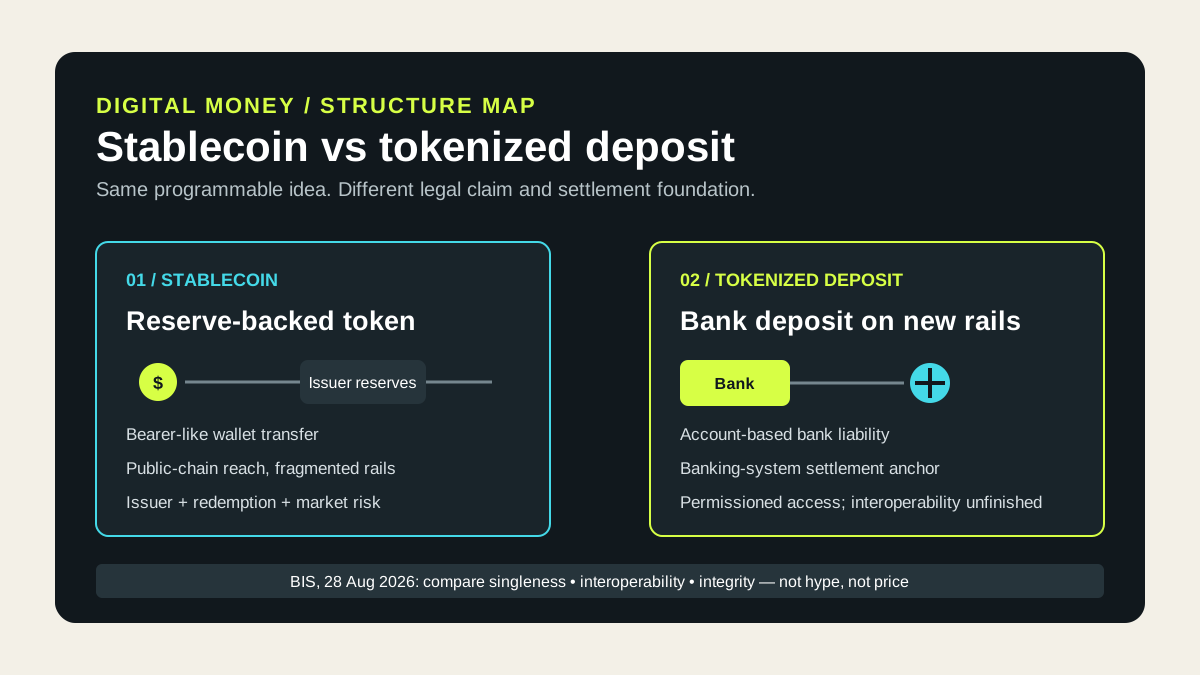
The core difference: what claim do you actually hold?
A tokenized deposit is still a deposit. The bank records the liability on a blockchain or another distributed ledger, but the holder’s claim remains against the issuing bank. The token changes the technical form of the record and potentially the way it can be programmed or settled; it does not turn the deposit into a reserve-backed cryptoasset.
A stablecoin is a different instrument. Fiat-referenced stablecoins such as dollar stablecoins are issued as tokens and are designed to maintain a reference value through reserves, redemption rights, market liquidity and issuer controls. Users frequently receive and transfer them through wallets and secondary markets rather than through an account at the issuer.
That distinction affects almost every downstream question: who owes you money, how redemption works, what happens during stress, which compliance perimeter applies, whether the asset can travel across open blockchain networks, and whether two forms of digital dollars exchange at par automatically.
Stablecoin vs tokenized deposit: side-by-side
| Question | Stablecoin | Tokenized deposit |
|---|---|---|
| What is the claim? | A token with a redemption claim supported by the issuer’s reserve arrangement. | A deposit liability of the issuing commercial bank. |
| Typical transfer model | Bearer-like token transferred between compatible wallets. | Account-based bank liability represented and moved on a programmable ledger. |
| Settlement foundation | Depends on the token, blockchain, issuer and redemption infrastructure. | Can remain connected to interbank settlement in central bank money. |
| Access | Can circulate on public blockchains and reach users outside a shared banking relationship. | Usually restricted to participating banks, customers or authorised counterparties. |
| Par exchange | Different stablecoins or chain versions may require secondary-market conversion and can deviate from par. | Designed to remain a bank-money claim denominated in the same unit as ordinary deposits. |
| Interoperability today | Broad crypto reach, but fragmented across tokens, chains and bridges. | Limited by permissioned platforms and bank-specific networks; not yet broadly interoperable either. |
| Primary risk layer | Issuer, reserves, redemption, market liquidity, custody, smart contracts and networks. | Bank credit, operational, cyber, platform, legal and network-design risks within the banking framework. |
This table is a structural comparison, not a statement that every product fits one identical template. Stablecoin regulation differs by jurisdiction and issuer. Tokenized deposit systems are still developing and may use private or public infrastructure with different access rules. Always verify the legal terms of the specific product rather than inferring them from a label.
What the BIS said on August 28, 2026
At the Jackson Hole Economic Symposium on August 28, BIS General Manager Pablo Hernández de Cos compared stablecoins and tokenized deposits against three monetary properties: singleness, interoperability and integrity. He argued that stablecoins in their current form do not yet satisfy the conditions needed to function credibly as a means of payment at scale, while tokenized deposits provide a more direct path to tokenisation without leaving the two-tier banking system.
The speech also leaves room for coexistence. De Cos said tokenized deposits should carry the bulk of day-to-day payments and wholesale settlement in a possible future system, while stablecoins could serve specialised roles such as decentralised lending, provided safeguards are strong enough. Reuters independently reported the same central conclusion from Jackson Hole.
This is a policy and monetary-system assessment from the BIS General Manager, not a new law and not a technical finding that every stablecoin payment fails. Stablecoins already settle real transfers and are used in trading, cross-border payments and crypto applications. The argument is narrower: scaling them into general-purpose money raises unresolved questions that policymakers would have to solve.
Why the BIS focuses on “singleness” and par value
Money works more smoothly when one unit is accepted as the same unit regardless of which bank or payment interface a person uses. The BIS calls this property singleness. Traditional bank deposits are supported by settlement in central bank money and institutional arrangements intended to make one dollar of deposit money exchange for another dollar at par.
Stablecoins do not automatically have the same mechanism across issuers. If a payer owns one dollar stablecoin and a recipient accepts another, conversion can require selling one token and buying the other. The exchange rate can move away from one-to-one, particularly during stress. Even the same token on different blockchains can require a bridge or issuer-specific cross-chain mechanism.
Tokenized deposits are designed to preserve the bank-liability relationship while changing the ledger technology. In the BIS model, interbank settlement through central bank accounts can keep different bank claims anchored to the same unit of account. That is the strongest part of the institutional argument for deposit tokens.
Stablecoins are open, but openness is not the same as interoperability
Stablecoins have a practical advantage today: compatible wallets on public blockchains can often receive a token without the sender and recipient sharing a bank. That portability helps explain their use in crypto markets and cross-border payment corridors.
But the ecosystem is fragmented. A token on Ethereum is not automatically usable on Solana, Tron or another network. Different stablecoins are separate instruments, and cross-chain transfers may depend on bridges, issuer protocols, liquidity pools or exchanges. Before moving funds, users still need to verify the exact token and network; our stablecoin transfer guide covers those operational checks.
Tokenized deposits do not solve interoperability today. De Cos explicitly noted that current examples are generally permissioned and that there is not yet a broad multi-bank, cross-jurisdictional interoperable ecosystem for tokenized deposits. The proposed advantage is that tokenized central bank reserves or interoperable ledger designs could create a common settlement foundation. That remains an engineering and institutional objective rather than a finished global network.
Why AML and financial integrity enter the comparison
Public blockchains allow assets to move through self-custodied wallets outside a continuous account relationship with a bank. The BIS argues that this makes anti-money-laundering and counter-terrorist-financing controls harder to enforce consistently across the complete transaction chain. Compliance may occur at issuers, exchanges and other regulated gateways while wallet-to-wallet transfers continue outside those venues.
Tokenized deposits start from an account-based and supervised environment, so identity and transaction controls can be integrated into the bank relationship. That can make compliance easier to administer, although it also means access is more permissioned and less cash-like than an open bearer token.
Neither architecture removes fraud, cyber risk or operational error. Users should not interpret “regulated bank deposit” as meaning a smart-contract or platform implementation cannot fail, just as a stablecoin’s reserve disclosure does not guarantee that every wallet, bridge or exchange is safe.
The BIS preference does not eliminate tokenized-deposit risks
The August speech is explicit that tokenized deposits remain ahead of current market reality. De Cos identified unresolved requirements including interoperability, clear governance and access rules, legal certainty around settlement finality and smart-contract enforceability, cyber resilience, error recovery and a migration path that can coexist with legacy systems.
Round-the-clock digital deposits can also change bank-run dynamics. If money can leave institutions more quickly, liquidity stress may accelerate. A tokenized deposit remains exposure to the issuing bank, so the quality of the bank and the applicable resolution and deposit-protection framework still matter.
Stablecoins carry a different risk stack: reserve composition, issuer governance, redemption access, secondary-market liquidity, custody, blockchain congestion, smart contracts and bridges. Review those layers in our stablecoin risk guide before treating a stable-value token as equivalent to cash in a bank account.
What should a user or business take away?
The useful question is not simply “which technology wins?” The answer depends on the job. Stablecoins can already reach open blockchain wallets and counterparties outside one bank network. That can be useful for crypto settlement and some cross-border workflows. Tokenized deposits can preserve a direct bank claim and potentially integrate programmable settlement with existing banking safeguards, but access and interoperability remain limited.
- Identify the legal claim. Determine whether you hold a reserve-backed token or a deposit liability of a bank.
- Check who can redeem. Do not assume every secondary-market holder has direct issuer redemption rights.
- Map the settlement path. Ask what blockchain, bank network, bridge, exchange or central-bank settlement asset sits between sender and recipient.
- Verify access rules. An institutional tokenized deposit may not be available to retail users; a stablecoin may be broadly transferable but restricted by jurisdiction or service provider.
- Compare the full risk stack. Regulation, reserves, bank credit, custody, code, operational resilience and network compatibility all matter.
For businesses deciding whether a stablecoin fits a real payment workflow, see our guide to accepting stablecoin payments. The BIS speech is a useful framework for understanding system design, but product selection still requires issuer-specific, network-specific and jurisdiction-specific checks.
Sources and status references
Bank for International Settlements, August 28, 2026 — primary speech comparing stablecoins and tokenized deposits across singleness, interoperability, integrity and macro-financial effects.
Reuters, August 28, 2026 — independent reporting on the Jackson Hole speech and the BIS General Manager’s conclusion.
Brookings, 2026 — independent structural comparison of payment stablecoins and tokenized bank deposits.
Return to the stablecoin guides hub for focused explainers on choosing stablecoins, transfer safety, issuer rules and current policy developments.