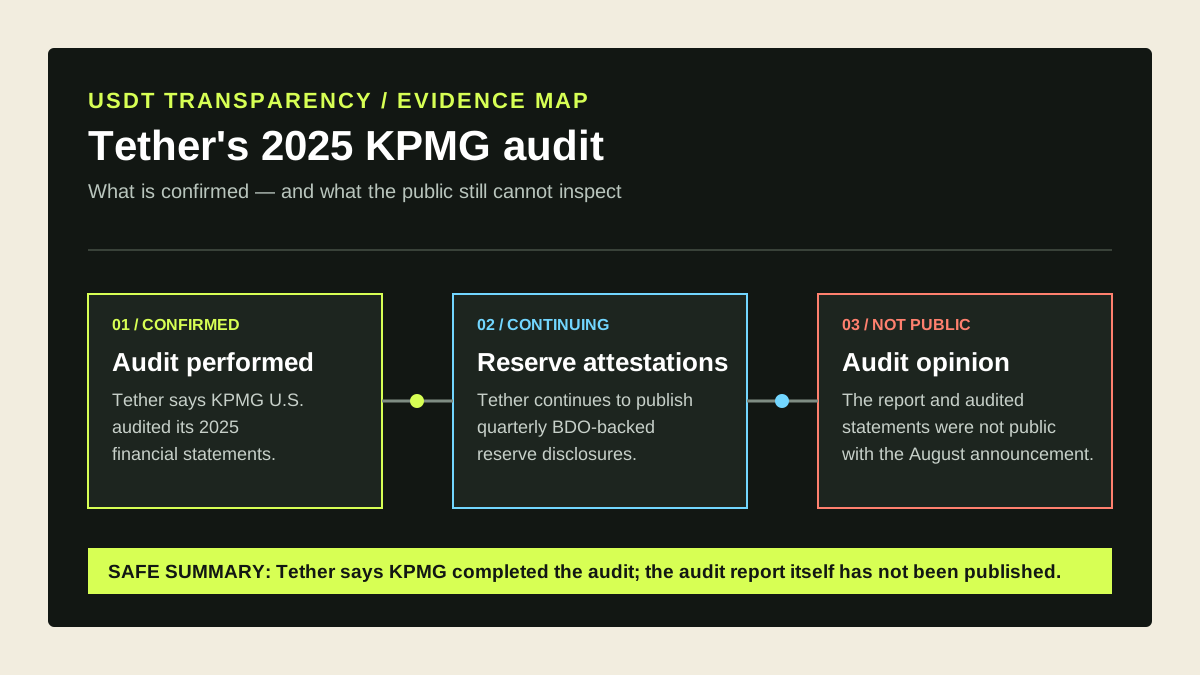
The short answer: yes, according to Tether’s August 2026 statement reported by Reuters, KPMG U.S. performed a full independent audit of Tether’s 2025 financial statements. But “an audit was performed” is not the same as “the public has seen an unqualified audit opinion.” Because the report itself is not public, it is too strong to claim that KPMG publicly verified every reserve claim, gave Tether a clean opinion, or resolved every transparency question.
What is confirmed about the Tether KPMG audit?
On August 14, 2026, Reuters reported that Tether said KPMG U.S. had performed a full independent audit of the company’s 2025 financial statements. Reuters described it as Tether’s first full independent audit. That is the strongest current confirmation of the completion event available publicly.
The audit did not appear without warning. On March 24, 2026, Tether publicly announced that it had entered a formal engagement with a Big Four accounting firm to complete its first full independent financial statement audit. Tether did not name the firm in that announcement. Two days later, the Financial Times reported that KPMG was the auditor and that PwC had been hired to help prepare internal systems for the audit.
Those three milestones should be kept separate: Tether’s March announcement confirmed a Big Four engagement, the Financial Times identified KPMG as the auditor, and the August Reuters report says Tether subsequently stated that KPMG U.S. had completed the audit of the 2025 statements.
| Date | What happened | What can be said safely |
|---|---|---|
| March 24, 2026 | Tether announced a Big Four audit engagement | A full financial statement audit had formally started |
| March 26, 2026 | Financial Times identified KPMG as auditor | KPMG was reported as the engaged audit firm |
| August 14, 2026 | Reuters reported Tether’s completion statement | Tether says KPMG U.S. performed the first full audit of its 2025 financial statements |
What has not been published?
The audit report itself was not made public with the August announcement. Reuters explicitly noted that the audit was not public. That creates an important evidence boundary: the existence and reported completion of the audit can be described, but the contents of the auditor’s report cannot be independently examined by the public yet.
Without the report, an outside reader cannot inspect the exact audit opinion, the financial statements and notes covered by that opinion, any qualifications or emphasis paragraphs, the basis for the opinion, or the detailed treatment of specific reserve and non-reserve assets. It would therefore be misleading to describe the result as a “clean audit” unless KPMG’s opinion or an equivalent public document supports that wording.
This distinction matters because stablecoin users often search for a binary answer to “is USDT audited?” The more accurate answer is now two-part: Tether says a full audit has been completed, but the public still lacks the audit report needed to judge the opinion and findings directly.
How is a full audit different from Tether’s reserve attestations?
Before this audit, Tether regularly published reserve reports accompanied by independent attestations. For example, its May 1, 2026 transparency update said BDO prepared the Q1 2026 attestation covering Tether’s reported financial figures and reserves as of March 31, 2026. The company also published a BDO-backed Q4 2025 attestation in January.
An attestation and a financial statement audit are not interchangeable labels. Tether itself has repeatedly distinguished the two, describing the Big Four engagement as a move beyond its existing attestation process. A quarterly reserve attestation is designed around specific management assertions and a defined reporting date. A financial statement audit addresses the financial statements as a whole under the audit framework used by the auditor.
That does not mean every financial statement audit automatically answers every question a token holder could ask. The usefulness of this particular audit depends on what statements were audited, the accounting framework, the auditor’s opinion and the accompanying disclosures. Until those documents are public, the safest conclusion is that the level of external assurance has changed, while the public evidence available to readers has not yet caught up.
| Question | Quarterly attestation | 2025 KPMG audit |
|---|---|---|
| Has Tether published this type of assurance before? | Yes, repeatedly | Tether describes it as its first full independent financial statement audit |
| Recent named firm | BDO | KPMG U.S., according to Tether as reported by Reuters |
| Public report available? | Attestation reports have been published with transparency updates | The August audit report itself has not been made public |
| Can the public inspect the auditor’s opinion? | For published attestation reports, yes within their stated scope | Not yet for the 2025 audit |
What does the audit mean for someone using USDT?
The completion of a first full financial statement audit is relevant because issuer transparency is one of the major variables in stablecoin risk assessment. It adds a new assurance process around Tether’s financial reporting. But a user should not treat the headline as a substitute for reading the underlying documents once they become available.
For a practical stablecoin decision, the audit is only one layer. Users still need to consider the issuer, reserve composition and liquidity, redemption access, custody, supported networks, smart-contract controls, platform exposure and jurisdiction. Our stablecoin risk guide explains why those failure modes should be evaluated separately rather than collapsed into a single “safe” or “unsafe” label.
The same applies when comparing USDT with another stablecoin. A stronger assurance process is useful information, but the decision should still match the intended use. A trader who needs deep exchange liquidity, a business that needs direct redemption, and a user sending funds on a specific network can rationally care about different factors. The stablecoin selection guide provides a broader framework for that comparison.
- Do not infer the audit opinion. Wait for the actual report before describing it as clean, qualified or otherwise.
- Do not confuse company financial statements with a token guarantee. Stablecoin risk also depends on redemption, operations, custody, networks and counterparties.
- Check the newest transparency material. Reserve composition and liabilities can change after the audited period.
- Keep the reporting date in view. The completed audit covers 2025 financial statements, while Tether continues to publish later quarterly information.
What should readers look for if the audit report is published?
If Tether or KPMG makes the audit report public, the next useful step is not simply to confirm that a PDF exists. Readers should inspect what the opinion actually says and what financial statements and notes it covers.
- Identify the exact reporting entity or entities included in the audited statements.
- Check the accounting framework and the period covered.
- Read the auditor’s opinion rather than relying on a press-release summary.
- Look for qualifications, emphasis paragraphs or other material auditor language.
- Compare audited year-end figures with the later quarterly reserve disclosures.
- Review how reserve assets, token liabilities, proprietary investments and related entities are presented in the notes.
- Separate findings about company financial reporting from operational risks involved in holding or transferring USDT.
If those documents become public, this guide can be updated narrowly with the actual opinion and relevant figures. Until then, the current evidence supports saying that Tether reports completion of the KPMG audit — not claiming a result that has not been disclosed.
Bottom line
Tether crossed an important transparency milestone in 2026: after formally engaging a Big Four firm in March, it said in August that KPMG U.S. had completed the first full independent audit of its 2025 financial statements. That changes the answer to the long-running question of whether Tether has undergone a full audit.
What it does not yet provide is public access to the audit opinion itself. For that reason, the most defensible summary is: Tether says KPMG completed the audit; the audit report has not been published. Readers evaluating USDT should treat those as two separate facts and continue to assess the other issuer, reserve, redemption and network risks described across the Bitcash stablecoin guides.
New to stablecoins? Start with the main how to buy stablecoin guide before choosing an asset or provider.
Sources
Reuters, August 14, 2026 — Tether’s statement that KPMG U.S. performed the first full independent audit of its 2025 financial statements, and the fact that the audit was not made public.
Tether, March 24, 2026 — official announcement of the Big Four audit engagement.
Financial Times, March 26, 2026 — identification of KPMG as auditor and reporting on PwC’s preparation role.
Tether Q1 2026 transparency update — example of the company’s continuing BDO attestation process after the audited 2025 period.