The short answer: the new objective is meant to require the Bank of England to consider payments innovation alongside its existing duties, while financial stability remains the priority. It would apply to the Bank’s regulation of systemic payment systems, including those using digital settlement assets such as stablecoins. The government expects to implement the change by amending the Financial Services and Markets Bill. That means the August 27 announcement sets policy direction, but the objective is not yet a completed statutory change.
What the UK announced on August 27, 2026
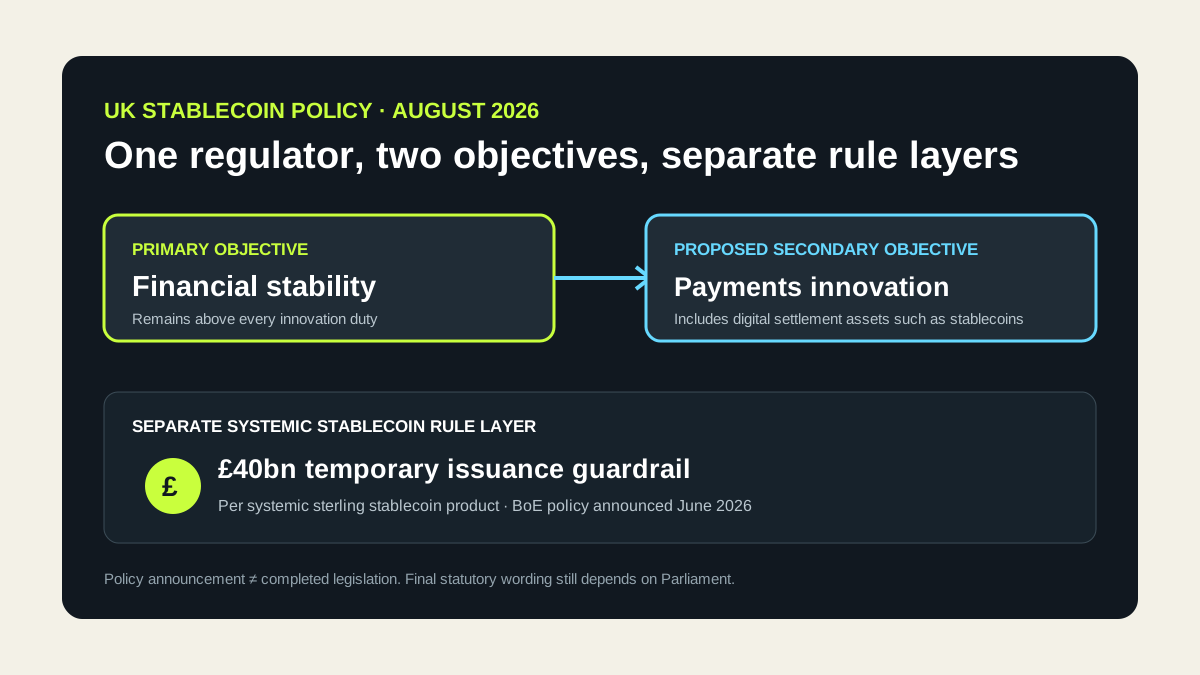
HM Treasury announced that the government intends to add a new secondary payments-innovation objective to the Bank of England’s statutory framework. The objective is designed to support innovation in payment systems and emerging forms of digital money while remaining subordinate to the Bank’s primary objective of protecting and enhancing UK financial stability.
The government explicitly connected the proposal to digital settlement assets, including stablecoins. The Bank already has a secondary innovation objective when regulating central counterparties and central securities depositories. The August proposal would extend that approach to systemic payment systems.
This distinction matters. A secondary objective does not instruct the Bank to approve every new payment product or weaken prudential controls. HM Treasury says the Bank would not be required to support an innovation where doing so would undermine financial stability. The Bank would also report annually to Parliament on how it is advancing the new objective.
What could change for stablecoin regulation?
The practical change is in how the Bank must frame decisions when regulating systemic payment infrastructure. Today, financial stability is the central statutory lens. Under the proposed framework, the Bank would still put stability first but would also have an explicit duty to consider whether its regulation supports safe innovation in payments and digital money.
For stablecoin issuers and payment businesses, that could matter when the Bank sets detailed requirements around systemic sterling stablecoins, settlement infrastructure and related payment systems. An explicit innovation objective creates a formal reason to evaluate whether a rule is proportionate, workable and compatible with new payment models, rather than treating innovation only as a discretionary policy consideration.
It does not guarantee lighter regulation. A systemic stablecoin can still create liquidity, redemption, operational, technology and financial-stability risks. The Bank’s own stablecoin policy continues to use reserve, redemption and issuance controls designed around those risks. Readers comparing stablecoins should therefore separate asset selection from the legal framework that governs a particular issuer or payment system.
What the new objective does not do
The August 27 announcement can be misunderstood if it is read as a complete rewrite of UK stablecoin rules. It is narrower than that.
- It does not legalise an unregulated stablecoin. Firms still need to comply with the applicable UK authorisation and regulatory regime.
- It does not remove the Bank’s primary financial-stability objective. The innovation objective is explicitly secondary.
- It does not cancel the Bank’s systemic stablecoin framework. Reserve, redemption and issuance requirements are a separate policy track.
- It does not create a retail holding limit. The Bank moved away from the temporary holding limits proposed previously.
- It does not mean every stablecoin is regulated by the Bank of England. The Bank’s role is focused on systemic arrangements; the FCA and other authorities have separate responsibilities within the wider UK framework.
For users, the important lesson is that “UK regulated” is not one binary label. The answer depends on the token, issuer, activity, scale, payment role and which regulator has jurisdiction. A token can be tradable in the UK without being a Bank of England-regulated systemic stablecoin.
How the £40 billion systemic stablecoin guardrail fits in
The new innovation objective should not be confused with the Bank of England’s June 2026 stablecoin policy statement. In that separate decision, the Bank dropped the temporary individual holding limits it had previously considered and instead proposed a temporary issuance guardrail for each systemic sterling stablecoin.
The initial guardrail is £40 billion per systemic stablecoin product. The Bank says individuals and businesses would be able to use systemic stablecoins without restrictions on the size, frequency or type of transaction arising from that guardrail, subject to other legal or regulatory requirements. The Bank plans to review the cap regularly and ultimately remove it once it is satisfied that risks to credit provision have been addressed.
| Policy element | Status | What it means |
|---|---|---|
| Payments innovation objective | Government proposal announced Aug. 27, 2026 | Would make innovation an explicit secondary Bank of England objective for systemic payment regulation. |
| Financial stability objective | Existing primary objective | Remains above the proposed innovation objective. |
| £40bn issuance guardrail | BoE systemic stablecoin policy announced June 2026 | Temporary maximum issuance per systemic sterling stablecoin product. |
| Individual holding limits | Not adopted in the June policy | The Bank chose an issuer-level guardrail instead of user-level temporary limits. |
The guardrail is relevant because it shows how the Bank is already trying to balance innovation with macro-financial concerns. The August objective would formalise that balancing requirement at the statutory-objective level; it would not erase the underlying risk controls.
What happens next?
HM Treasury says the government expects to make the change through amendments to the Financial Services and Markets Bill. The government announcement states that the Bill is next due to be debated in the House of Lords on September 7 and September 9, 2026.
Until the legislative process is complete, the safest description is proposed secondary objective. The exact statutory wording can still change during parliamentary consideration. A reader should therefore distinguish three layers: the government’s announced policy, the text that is ultimately passed by Parliament, and the detailed regulatory rules the Bank applies afterward.
The broader UK crypto regime is also developing on a different timetable. HM Treasury’s April 2026 policy note says the Financial Services and Markets Act 2000 (Cryptoassets) Regulations 2026 are expected to come into force in October 2027, subject to the legislative framework. Those rules cover a wider set of cryptoasset activities and should not be collapsed into the Bank’s systemic-stablecoin responsibilities.
What should stablecoin users and businesses watch?
For most users, the announcement does not require an immediate action. It changes the direction of regulation rather than a wallet setting, token contract or transfer procedure. The useful questions are about what happens next.
- Watch the Bill wording. Confirm whether the final legislation gives the Bank the objective described by HM Treasury and whether Parliament changes its scope.
- Separate systemic from non-systemic stablecoins. The Bank of England framework is not the only UK regulatory layer.
- Check issuer-specific status. Regulation attaches to legal entities and activities, not just a familiar ticker.
- Follow the final stablecoin rules. The £40bn guardrail and reserve framework may evolve as the Bank completes implementation.
- Do not treat regulation as a substitute for asset checks. Users still need to examine reserves, redemption, custody, network support and operational risk. See our stablecoin risk guide.
Businesses evaluating stablecoin settlement should also distinguish policy eligibility from operational readiness. A legally available stablecoin can still be a poor fit if its settlement network, custody model, reconciliation process or redemption route does not match the business workflow. Our stablecoin payments guide covers those implementation checks.
Sources and status references
HM Treasury, August 27, 2026 — official announcement of the proposed secondary payments-innovation objective and expected legislative route.
Bank of England, June 2026 — systemic stablecoin policy decisions, including the £40bn issuance guardrail and removal of proposed individual holding limits.
Bank of England systemic stablecoin policy statement — detailed guardrail rationale and transition framework.
Reuters, August 27, 2026 — independent confirmation and policy context.
UK Parliament — parliamentary context for the Financial Services and Markets Bill.
Return to the stablecoin guides hub for focused explainers on stablecoin selection, transfers, risks and current regulatory developments.