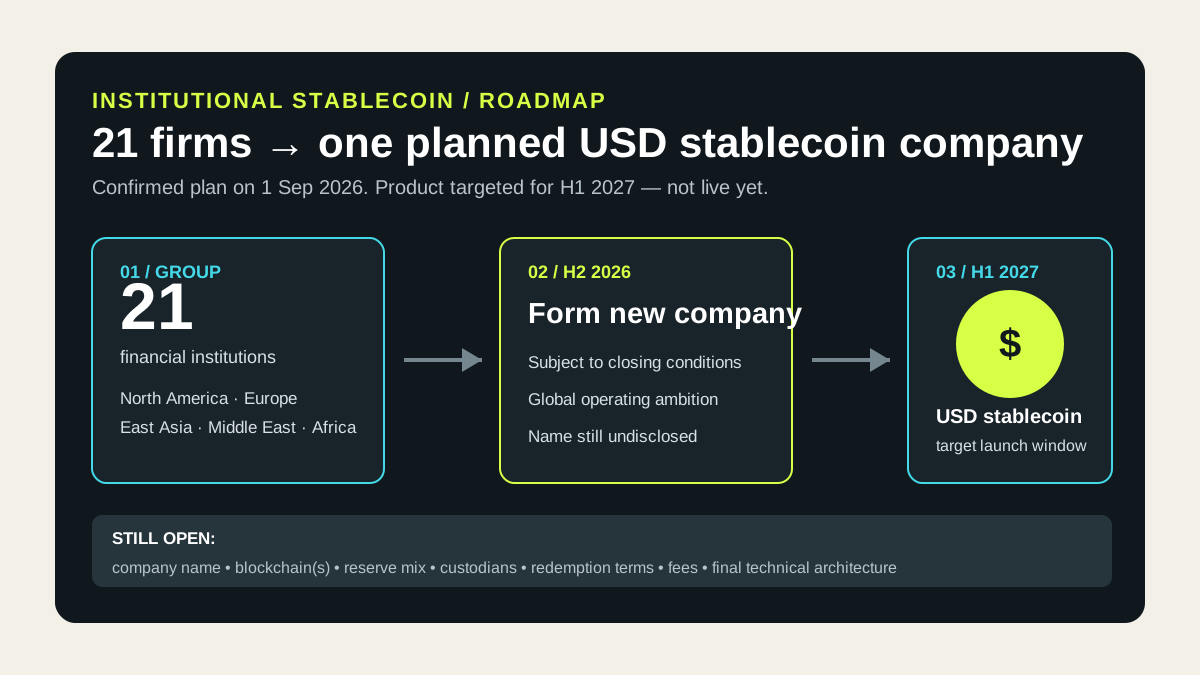
The short answer: the project is real, but the stablecoin is not live yet. The participating firms have committed to form a new company and target a USD stablecoin launch in H1 2027. They say the product is intended for wholesale, institutional and retail use, including cross-border payments and digital-asset settlement, and that it is intended to comply with the U.S. GENIUS Act and EU MiCA where applicable. The company name, blockchain networks, reserve composition, custodians, redemption terms and final technical architecture have not yet been published.
What the September 1 announcement actually confirms
The participating institutions said they have committed to establish a new company in the second half of 2026, subject to closing conditions. That company is intended to operate globally and support stablecoin issuance. The first focus is a U.S. dollar-denominated token, with a target go-to-market window in the first half of 2027.
The announcement is an expansion of an earlier October 2025 initiative, when a group of ten banks said they were exploring a 1:1 reserve-backed form of digital money available on public blockchains. The September 2026 statement moves the project from exploration to a commitment to form a company, but it still contains forward-looking language and does not mean the token has been issued.
Which 21 institutions are involved?
The group spans North America, Europe, East Asia, the Middle East and Africa. The official announcement lists Bank of America, Capital One, Citi, Fidelity Investments, Goldman Sachs, PNC Financial Services, Scotiabank, TD Bank Group, Wells Fargo and WisdomTree in North America.
European members are Banco Santander, BBVA, Commerzbank, Crédit Agricole, Deutsche Bank, Lloyds Banking Group, Rabobank and UBS. MUFG Bank represents East Asia, Sirius International Holding represents the Middle East and Standard Bank represents Africa.
That breadth matters because the project is not simply one bank testing a closed internal token. The stated ambition is a globally operating stablecoin business supported by institutions with banking, asset-management, distribution, compliance and settlement capabilities across several major jurisdictions.
What has not been published yet?
The most important missing details are technical and contractual. The September 1 release does not name the new company, identify supported blockchains, disclose reserve composition, name reserve custodians, explain who will be allowed to redeem directly, publish fees, or provide final token terms.
It also does not publish an independent reserve report, legal opinion, regulatory approval letter or final rule mapping. That does not invalidate the announcement; it simply means those items cannot yet be independently evaluated. Readers should separate the consortium’s stated intentions from facts that will become verifiable only after the entity, product documentation and regulatory path are public.
| Confirmed now | Still not published |
|---|---|
| 21 participating institutions | Final company name and ownership structure |
| Company targeted for H2 2026 | Supported blockchain networks |
| USD stablecoin targeted for H1 2027 | Reserve composition and custodians |
| EUR stablecoin is the next currency priority | Redemption eligibility and terms |
| Wholesale, institutional and retail use cases | Fees, token contract and technical architecture |
What is the planned stablecoin supposed to do?
The consortium names cross-border payments and digital-asset settlement as concrete examples, while also saying the product is intended for wholesale, institutional and retail markets where a trusted form of digital money creates client benefits.
That places the project closer to payment and settlement infrastructure than to a purely crypto-trading token. For businesses, the relevant question will be whether the eventual product actually reduces friction across payment routes, counterparties and jurisdictions after custody, compliance, conversion and redemption are included. Our stablecoin payment guide explains the operational checks a merchant still needs even when the issuer is a major financial institution.
For users, a bank-backed brand does not remove blockchain or custody risk. The exact network, wallet support, contract, freeze controls, redemption process and service availability will still determine how the token can be used in practice.
What does “GENIUS Act and MiCA-compliant” mean here?
The consortium says the initiative intends to be compliant with the U.S. GENIUS Act and the EU Markets in Crypto-Assets Regulation where applicable. That is a stated design objective, not evidence that every regulatory approval has already been granted.
The distinction is important because the project is still pre-launch. The applicable issuer structure, reserve rules, supervisory obligations and authorization path depend on where the company is formed, where individual tokens are issued and which customers are served. Until those details are disclosed, the safest reading is that the group is designing toward those regulatory frameworks rather than announcing completed authorization.
This also means readers should avoid treating the membership list as a substitute for product-level due diligence. A consortium can bring strong governance and compliance expertise while still needing to publish clear reserve, redemption and operational terms for the specific token.
How is this different from tokenized deposits?
The planned product is described as a stablecoin, not a tokenized bank deposit. That distinction matters. A tokenized deposit remains a liability of a commercial bank. A stablecoin is a separate token whose legal and economic structure depends on the issuer, reserve arrangement and redemption framework.
Large financial institutions are exploring both models. The existence of this consortium does not settle the broader debate about which architecture is better for payments. The BIS has recently argued that tokenized deposits preserve the singleness of commercial bank money more naturally, while stablecoins offer different portability and open-network characteristics. Our stablecoins vs tokenized deposits guide compares the two structures in detail.
The consortium’s eventual documentation will therefore matter more than the word “bank” in the headline. If the product launches on public blockchains with direct wallet transfer, broad distribution and reserve-backed redemption, it will behave differently from a deposit token restricted to participating bank customers.
What should users and businesses watch next?
- Company formation. Confirm the legal entity, domicile, ownership and governance structure once announced.
- Issuer and reserve terms. Look for the exact issuing entity, reserve assets, custodians, segregation rules and disclosure schedule.
- Redemption rights. Check who can redeem directly, minimum amounts, settlement timing and fees.
- Blockchain support. Verify whether the token launches on one or several public networks and whether versions are native or bridged.
- Regulatory status. Distinguish stated compliance intent from completed authorization in each jurisdiction.
- Distribution. See which banks, exchanges, wallets and payment providers actually support deposits, withdrawals and settlement.
Until those details are public, there is no token contract to verify, no live reserve structure to assess and no reason for users to take operational action. The useful takeaway today is narrower: a 21-member financial consortium has moved from exploratory work to a committed company-formation plan, with a USD stablecoin targeted for H1 2027.
Sources and status references
Banco Santander, September 1, 2026 — participant publication confirming the company-formation commitment, member list, planned use cases and 2027 target.
Wells Fargo, September 1, 2026 — participant publication carrying the same consortium announcement and forward-looking caveat.
Reuters, September 1, 2026 — independent confirmation of the 21-member plan and intended H1 2027 USD stablecoin launch.
For broader selection and issuer-risk checks, continue with how to choose a stablecoin or return to the stablecoin guides hub.