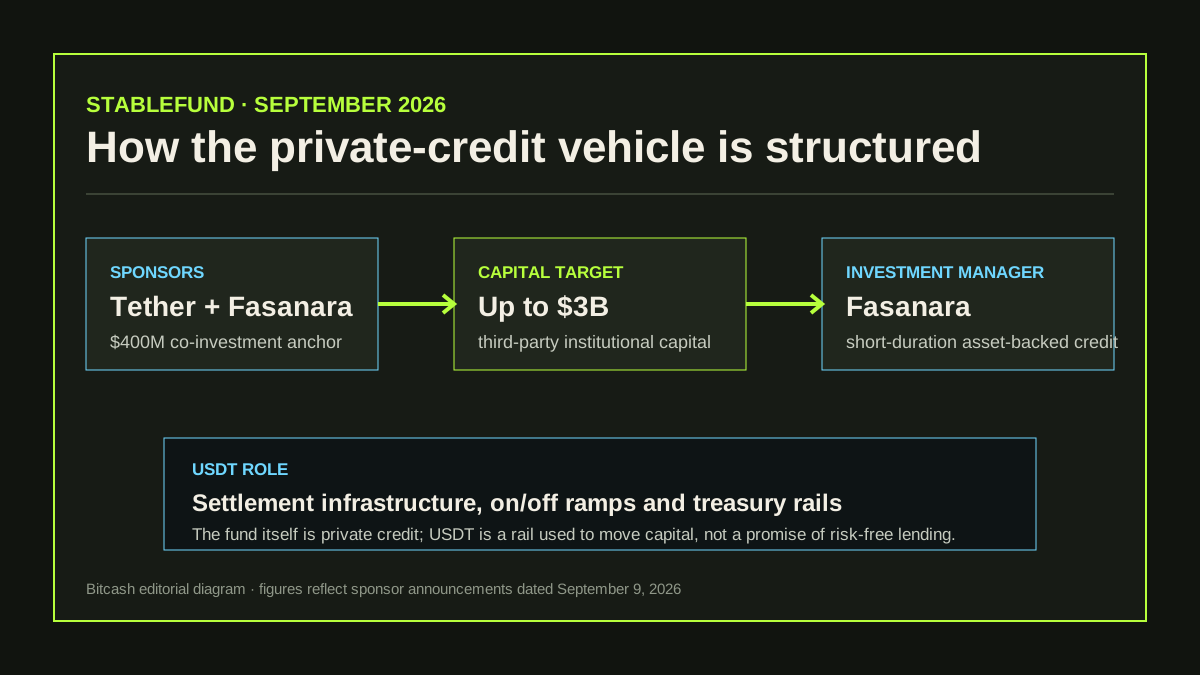
The short answer: StableFund is not a new stablecoin and it is not a savings account backed by Tether. It is a private-credit fund managed by Fasanara. Tether and Fasanara say they are anchoring it with $400 million, while the fund targets up to $3 billion of third-party institutional capital. Fasanara plans to deploy capital into short-duration, asset-backed credit through fintech lenders, while Tether is expected to source USDT-linked financing opportunities and provide stablecoin settlement infrastructure, including on/off ramps and treasury rails.
What the September 9 launch confirms
Tether and Fasanara jointly announced StableFund on September 9. Their releases describe it as an evergreen private-credit vehicle anchored by $400 million in co-investment from the two sponsors. The stated goal is to attract up to $3 billion of third-party institutional capital.
Fasanara is the investment manager. The companies say capital will be deployed through Fasanara's fintech lending network into short-duration, asset-backed credit strategies. They identify small and medium-sized businesses and consumer lending among the target areas.
Independent reporting from the Financial Times, CoinDesk and The Block confirms the core structure: a $400 million sponsor commitment, a larger third-party fundraising target, Fasanara as investment manager and a role for USDT in cross-border settlement and treasury flows.
How is StableFund structured?
The structure separates investment management from stablecoin infrastructure. Fasanara is responsible for selecting and managing credit exposure. Tether is a co-sponsor, originator and adviser that says it will help source financing opportunities linked to USDT and provide the payment and settlement rails used by the fund's network.
| Part of the structure | What is confirmed |
|---|---|
| Sponsor capital | $400 million of co-investment from Tether and Fasanara |
| Fundraising target | Up to $3 billion of third-party institutional capital |
| Investment manager | Fasanara Capital |
| Credit strategy | Short-duration, asset-backed private credit |
| Distribution network | Fintech lending platforms operating across more than 60 countries, according to the sponsors |
| Stablecoin role | USDT-linked settlement infrastructure, on/off ramps and treasury rails |
This matters because headlines can make the project sound like Tether is directly issuing billions of dollars of loans from USDT reserves. The announced structure is narrower: the fund is a private-credit vehicle, Fasanara manages investments, and Tether provides capital, origination support and stablecoin infrastructure.
What does USDT actually do in the fund?
The sponsors describe USDT as infrastructure for moving capital, not as the underlying credit asset itself. Tether says it will provide stablecoin settlement rails that connect on-chain and off-chain money movement, including conversions between traditional currencies and digital dollars.
That could reduce some operational friction when capital moves between jurisdictions, lenders and treasury accounts. But using a stablecoin does not remove credit risk. A borrower can still default, collateral can lose value, legal enforcement can vary by jurisdiction and a lender can face liquidity or operational problems.
For the same reason, StableFund should not be confused with holding USDT. A person who owns USDT holds a stablecoin issued by Tether. An institutional investor in StableFund would instead have exposure to a private-credit investment vehicle whose returns and losses depend on its portfolio and legal terms.
If you are comparing the payment side rather than the investment side, our stablecoin payments guide explains why settlement rails still need custody, conversion, compliance and reconciliation controls around them.
Who is StableFund designed to finance?
The official releases say the fund will focus on small and medium-sized businesses and consumers that may be underserved by conventional financing channels. Fasanara says its network includes fintech lenders across more than 60 countries and covers areas such as SME loans, consumer credit, trade receivables and supply-chain finance.
Those categories are broad. They do not tell investors which individual borrowers, countries, credit scores, collateral pools or underwriting models will dominate the portfolio. That information would need to come from fund documentation, investor materials and future portfolio disclosures.
The useful takeaway today is therefore structural rather than predictive: the partners are combining institutional private-credit underwriting with stablecoin-based treasury and settlement tools. Whether that results in lower costs, faster funding or better borrower access will depend on execution and cannot be established from the launch announcement alone.
What the launch does not mean
- It does not mean $3 billion has already been raised. That is the stated target for third-party institutional capital.
- It does not make private credit equivalent to cash. Credit assets can default, be restructured or become illiquid.
- It does not mean USDT holders automatically earn fund returns. StableFund is a separate investment vehicle.
- It does not prove cross-border settlement will always be cheaper. FX conversion, compliance, custody, banking and on/off-ramp costs can still matter.
- It does not disclose a complete portfolio. The announcement describes strategy categories, not every borrower or asset.
The launch also does not change the basic questions users should ask about USDT itself: issuer exposure, reserve transparency, redemption access, supported networks and custody. Our separate Tether audit guide covers the distinction between Tether's corporate financial audit claims and recurring reserve attestations.
Main risks and open questions
Credit and underwriting risk
Private-credit returns depend on borrowers repaying. Asset-backed structures can reduce loss severity in some cases, but collateral values, recovery timelines and legal enforceability still matter. A stablecoin rail does not alter the underlying borrower's ability to pay.
Liquidity risk
Evergreen funds can offer a continuing investment structure, but the word “evergreen” does not guarantee immediate liquidity. Redemption terms, gates, notice periods and asset liquidity need to be checked in the fund's actual offering documents.
Cross-border legal and operational risk
A lending network spanning many countries can encounter different insolvency laws, consumer-credit rules, sanctions controls, data requirements and currency restrictions. Stablecoin settlement may speed up money movement while leaving those legal obligations intact.
Stablecoin and infrastructure risk
Where USDT is used for settlement, the workflow can inherit issuer, blockchain, wallet, smart-contract, operational and on/off-ramp risks. Investors should distinguish risks created by the loan portfolio from risks created by the payment infrastructure.
Disclosure risk
The launch announcement provides headline strategy information, but it is not a substitute for full fund documents. Investors would still need the legal vehicle, domicile, fee schedule, redemption policy, leverage limits, valuation policy, service providers, audit arrangements and portfolio reporting before evaluating the fund in detail.
What should readers watch next?
- Third-party fundraising. Track how much of the “up to $3 billion” target is actually committed and on what timetable.
- Fund documents. Look for the legal vehicle, domicile, fees, liquidity terms and investor eligibility.
- Portfolio composition. Watch for country, borrower, collateral and lender concentration.
- USDT settlement details. Confirm which chains, custodians, banks and on/off-ramp providers are used.
- Performance reporting. Separate realized portfolio results from sponsor projections about efficiency or market opportunity.
StableFund is a useful example of how stablecoin infrastructure is moving beyond trading and merchant payments into institutional capital markets. The notable change is not that private credit suddenly becomes “on-chain,” but that a large stablecoin issuer is being embedded directly into the operational rails of a conventional lending strategy.
Sources and status references
Tether, September 9, 2026 — sponsor announcement describing the $400 million anchor, $3 billion target, fund strategy and Tether's infrastructure role.
Fasanara Capital, September 9, 2026 — investment-manager announcement confirming the fund structure and lending strategy.
Financial Times, September 9, 2026 — independent reporting on the launch, capital target and Tether's broader strategy.
CoinDesk, September 9, 2026 — independent reporting on Fasanara's lending network and USDT settlement role.
The Block, September 9, 2026 — independent confirmation of the sponsor capital, fundraising target and operating model.
For a broader framework, continue with stablecoin risks, stablecoins vs tokenized deposits, or return to the stablecoin guides hub.