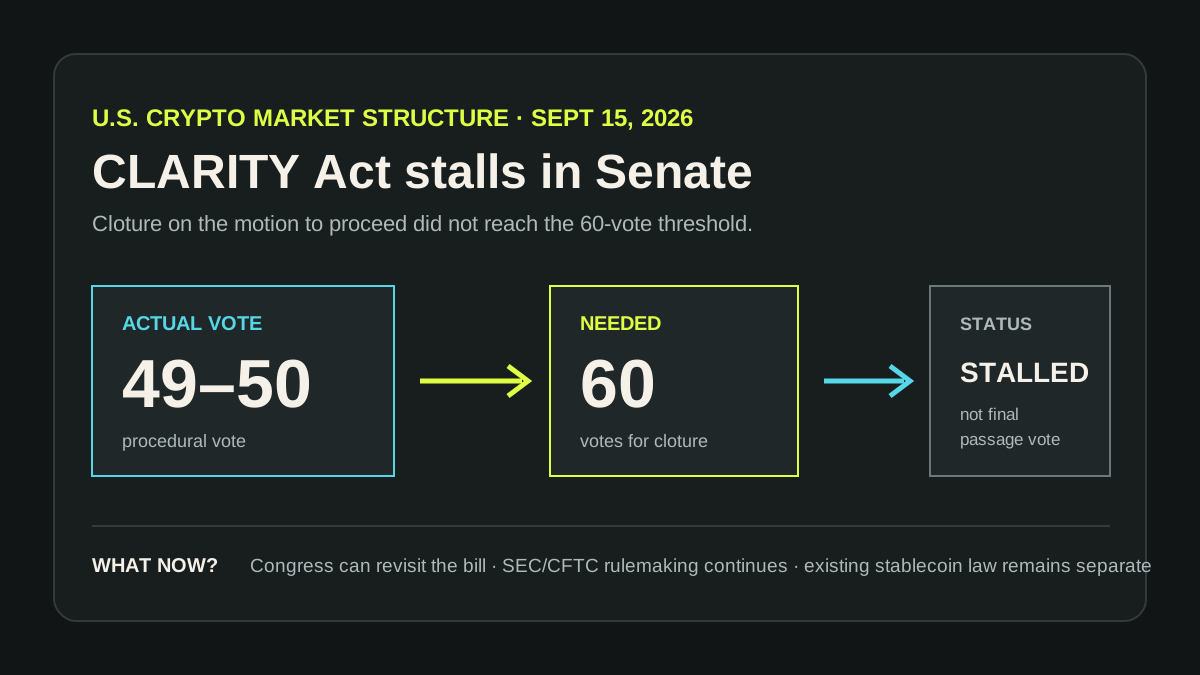
The short answer: the CLARITY Act did not pass the Senate on September 15, 2026. Senators were voting on whether to invoke cloture on the motion to proceed — a procedural step needed to move toward considering the bill. The motion failed 49–50 and needed 60 votes. The result leaves the bill stalled, keeps existing law and agency authority in place, and shifts near-term attention back to Congress, the SEC and the CFTC.
What is confirmed about the September 15 vote?
Reuters reported that the Senate failed to advance the comprehensive crypto legislation after the motion fell short of the 60 votes required. The recorded procedural outcome was 49–50. Senate Banking Committee Chairman Tim Scott also acknowledged after the vote that the motion fell short and said the SEC and CFTC should continue setting rules while Congress works on legislation.
Several senators who voted against cloture published statements describing unresolved concerns around ethics, illicit finance, enforcement capacity and other provisions. Those statements help explain the political dispute, but they are advocacy from individual lawmakers rather than neutral findings about the bill.
What did the Senate vote actually decide?
The vote concerned cloture on the motion to proceed. In practical terms, supporters needed 60 votes to clear the procedural barrier and move the legislation toward floor consideration. They did not get them.
| Question | Answer after September 15 |
|---|---|
| Did the CLARITY Act become law? | No. |
| Did the Senate hold a final passage vote? | No. The failed vote was procedural. |
| Did the motion reach the 60-vote threshold? | No. The result was 49–50. |
| Are existing SEC/CFTC rules automatically repealed? | No. The vote did not itself rewrite current regulatory authority. |
| Can Congress revisit market-structure legislation? | Yes. The failed motion does not legally prevent a later attempt. |
This distinction matters for searchers trying to understand headlines saying the bill “failed.” The immediate legislative path failed; the underlying policy debate did not disappear.
What was the CLARITY Act trying to change?
The legislation was designed to create a more explicit federal market structure for digital assets, including clearer boundaries between securities regulation and commodities regulation. Reuters described the bill as an effort to establish comprehensive rules for crypto markets after years of uncertainty over how different tokens, trading venues and intermediaries fit under existing law.
That objective is broader than stablecoins. Market structure touches token classification, exchange and broker obligations, regulator jurisdiction, customer protections and the rules under which digital-asset businesses operate. The failed procedural vote therefore should not be read as a vote specifically on USDT, USDC or any one issuer.
For users, the most important boundary is that a stalled market-structure bill does not erase laws that already exist. Separate federal statutes, state rules, sanctions obligations, anti-money-laundering requirements and agency actions continue to apply according to their own scope.
Why did stablecoins still matter to the CLARITY debate?
Stablecoin rewards and their relationship to bank deposits were one of the recurring points of negotiation around broader crypto legislation. Reuters reported before the vote that banking groups were concerned about competition for deposits, while crypto companies argued for rules that would preserve digital-asset product models. The final political dispute also included ethics and other safeguards, so it would be misleading to say stablecoin yield alone killed the bill.
It is also important to separate the CLARITY Act from stablecoin-specific law and rulemaking. A market-structure setback does not automatically cancel issuer obligations or regulatory work created through other statutes. Our stablecoin customer-identification proposal guide covers one such separate rulemaking track, while the stablecoin trust bank charter guide explains another regulatory pathway.
What happens next?
Congress can negotiate again. The September 15 result blocks the planned path, but lawmakers can revise language, seek reconsideration or pursue market-structure provisions through another legislative vehicle. There is no confirmed date for a successful new vote, so any article claiming a guaranteed next passage date would be speculation.
The SEC and CFTC remain central. Chairman Scott's post-vote statement explicitly pointed to the two agencies for near-term rules of the road while Congress continues legislating. Agency rulemaking cannot necessarily reproduce every provision Congress might enact, but the failed vote does not freeze regulatory activity.
Businesses still need to follow current rules. Exchanges, issuers, payment providers and users should not treat a failed bill as a regulatory holiday. The legal position of a product depends on existing statutes, agency rules, court decisions and jurisdiction-specific requirements, not on the expectation that CLARITY might eventually pass.
What should stablecoin users and businesses take from the vote?
- Do not change custody or transfer behavior because of the vote alone. It did not alter a blockchain, stablecoin contract or wallet balance.
- Do not assume every U.S. crypto rule is now unresolved. Market structure is only one layer of regulation.
- Watch regulator actions separately from Congress. SEC, CFTC, banking and stablecoin-specific rulemaking can move on different timelines.
- Verify product-specific requirements. A payment processor, exchange, issuer or wallet can face obligations that are independent of CLARITY.
- Treat future vote dates as provisional until officially scheduled. The bill can return, but the next successful path is not confirmed.
For operational decisions, the same principle used in our stablecoin risk guide applies here: regulatory risk is one layer alongside issuer, reserve, custody, network and smart-contract risk. A headline about Congress should not substitute for checking the specific asset and service you use.
Sources and verification status
Reuters, September 15, 2026 — independent reporting on the failed procedural vote, threshold and immediate legislative status.
U.S. Senate Banking Committee, September 15, 2026 — Chairman Tim Scott's post-vote statement and near-term SEC/CFTC framing.
Senator Mark Warner, September 15, 2026 — primary statement from a senator voting against cloture, including ethics concerns.
Senator Dave McCormick, September 15, 2026 — primary post-vote confirmation that the procedural effort fell short of 60 votes.
For related context, see all stablecoin guides, UK stablecoin regulation, Singapore's 2026 stablecoin proposal, or return to the Bitcash stablecoin buying guide.